
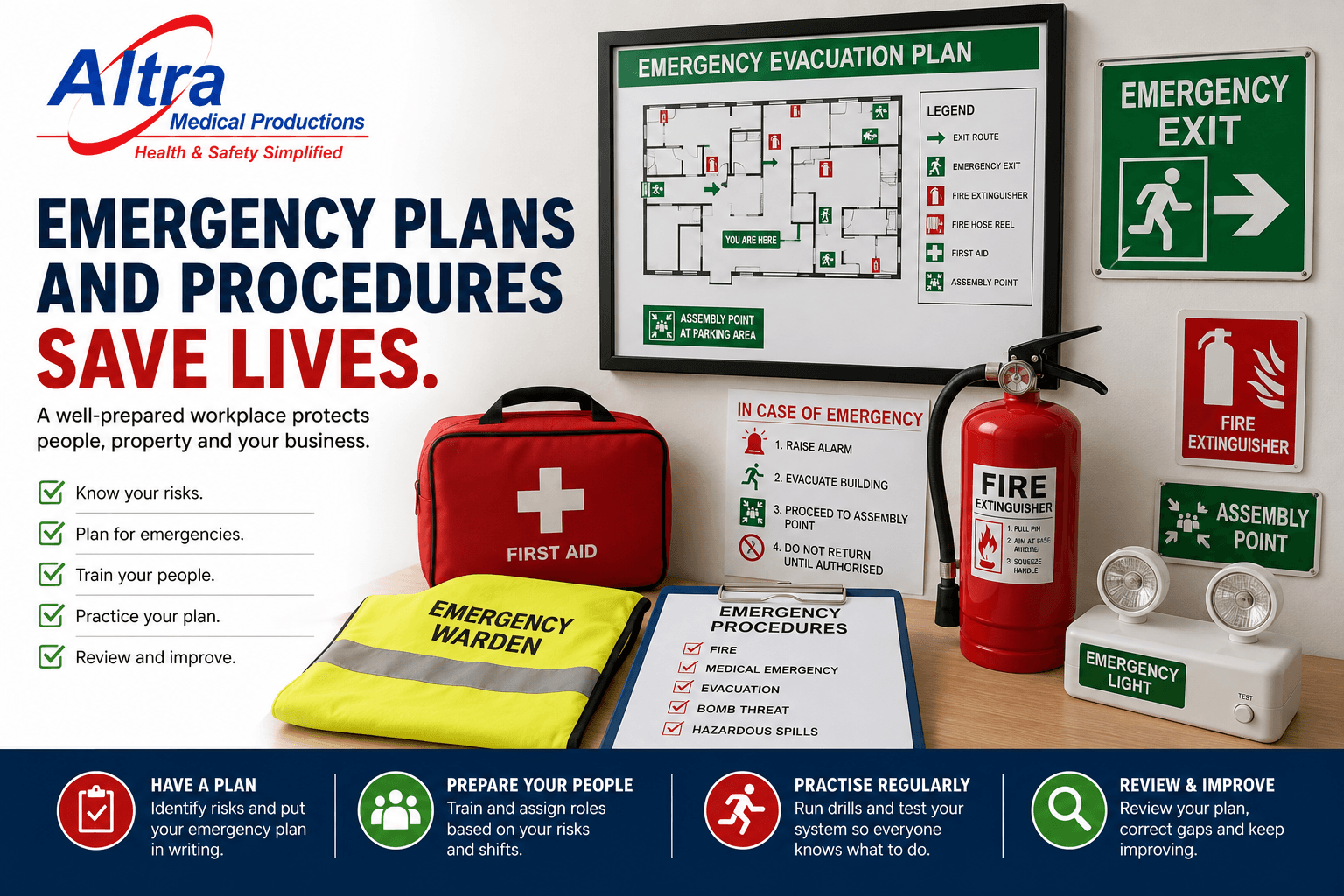

Every workplace needs emergency arrangements that match its actual risks, people, premises and activities. There is not one universal emergency-plan template or one fixed list of wardens that applies to every South African employer, but the OHS Act and its regulations require employers to provide a safe workplace, suitable emergency precautions, safe means of escape and the training and arrangements needed for foreseeable emergencies.
The practical test is simple: if something serious happened today, would your employees know what to do, who is in charge, how to evacuate and where to get immediate assistance?
Direct answer: A workplace emergency system should normally address fire, evacuation, first aid, communication, emergency responsibilities, visitors and contractors, people requiring assistance, assembly and accountability, and the specific emergencies identified by the workplace risk assessment. These arrangements should be documented, communicated, tested and updated when conditions change.
Emergency preparedness is more than an evacuation map
Many companies have an evacuation diagram on the wall and assume they have an emergency plan.
An evacuation map is useful, but it is only one part of the system.
A functioning emergency arrangement should explain what happens from the moment an emergency is discovered until employees are safe and the incident is handed over to the appropriate emergency service or responsible person.
That means answering practical questions such as:
Who raises the alarm? Who calls emergency services? Who directs employees? Who checks specific areas? Who assists injured people? Who accounts for staff and visitors? Who is authorised to re-enter the building?
1. Is a written emergency plan compulsory for every workplace?
The legal position is more nuanced than many websites suggest.
The OHS Act places broad duties on employers to identify and control hazards and to provide the information, instruction, training and supervision needed for safe work. The General Safety Regulations also contain specific requirements for first aid, fire precautions and means of egress.
Some specialist regulations impose more explicit emergency-planning duties for particular high-risk activities or installations.
For an ordinary workplace, a documented emergency plan remains one of the clearest ways to organise and demonstrate how the employer will respond to foreseeable emergencies.
The important issue is not whether you own a document titled “Emergency Plan”. The important issue is whether your emergency arrangements are suitable for your actual workplace and can be implemented when needed.
2. What emergencies should the plan consider?
The starting point should be the workplace risk assessment.
Different workplaces face different emergencies. A general office may have a relatively simple risk profile, while a factory, warehouse or chemical operation may require far more detailed arrangements.
Foreseeable emergencies may include:
- Fire or smoke;
- Serious injury or medical emergency;
- Chemical spill or release;
- Gas leak;
- Electrical incident;
- Explosion;
- Structural failure;
- Flooding;
- Severe weather;
- Security threats;
- Loss of critical utilities;
- Confined-space emergency;
- Work-at-height rescue; or
- Any other credible emergency created by the workplace’s activities.
The plan should focus on realistic hazards rather than copying a generic list that does not match the site.
3. What must the fire and evacuation arrangements cover?
The General Safety Regulations were amended in 2025 to include Regulation 13J dealing specifically with fire precautions and means of egress.
Among other things, employers must keep escape doors and routes clear and capable of being opened quickly, keep fire-escape stairways clear, provide suitable means of egress and provide suitable firefighting equipment having regard to the workplace and fire risk. citeturn394942search19
Your emergency procedure should translate those physical requirements into practical actions for employees.
It should identify:
- How the alarm will be raised;
- When evacuation must begin;
- Which escape routes should be used;
- Alternative routes where necessary;
- The assembly point or points;
- Who coordinates evacuation;
- How visitors and contractors are managed;
- How people requiring assistance are supported; and
- Who communicates with emergency services.
4. Do we legally need evacuation wardens?
There is no single universal ratio in the general OHS legislation stating that every employer must appoint one evacuation warden for a fixed number of employees.
However, if your emergency plan relies on designated people to sweep areas, direct employees, check toilets, manage assembly points or assist specific occupants, those people need to be clearly identified and competent for the role.
The number should be based on:
- Building size;
- Number of floors;
- Occupancy;
- Shift patterns;
- Separate departments or buildings;
- Visitors and contractors;
- People requiring assistance; and
- The time needed to evacuate safely.
One warden for an entire multi-storey building may be technically convenient on paper but practically useless during an emergency.
5. Do we need trained firefighters?
The General Safety Regulations require suitable firefighting equipment based on factors such as the size, construction and location of the workplace and the amount and type of flammable material present. citeturn394942search19
The regulations do not create one universal rule requiring every workplace to send a fixed number of employees on a course titled “Basic Fire Fighting”.
However, if the employer expects designated employees to use firefighting equipment during an incipient-stage fire, those employees need appropriate training and should understand when it is safe to attempt first-aid firefighting and when evacuation takes priority.
That decision should be based on the fire risk assessment and emergency response strategy.
6. How does first aid fit into the emergency plan?
First aid should not sit in a separate file with no connection to the emergency system.
The emergency plan should identify:
- Who the trained first aiders are;
- Where they are normally located;
- How they are contacted;
- Where first aid boxes or equipment are kept;
- How ambulance services are contacted;
- How emergency vehicles gain access; and
- Who meets and directs emergency responders.
If the workplace operates shifts, the emergency plan should reflect who is actually available on each shift.
Related article: Does Every Shift Need Its Own Trained First Aider?
7. What about emergency lighting?
The Environmental Regulations for Workplaces require emergency lighting in indoor workplaces without natural lighting or where people habitually work at night, subject to the circumstances described in the regulation.
The emergency lighting must activate quickly enough, last long enough for safe evacuation and be kept in good working order. The regulations require testing at intervals not exceeding three months. citeturn394942search21
This is a good example of why emergency preparedness must include both procedures and physical systems.
8. What should happen when an emergency is discovered?
The first actions should be simple enough for employees to remember under pressure.
A typical sequence may be:
- Raise the alarm.
- Notify the appropriate internal responsible person.
- Contact emergency services where required.
- Stop work or isolate equipment where this can be done safely.
- Evacuate or move to the designated safe area.
- Provide first aid where appropriate.
- Account for people.
- Provide information to emergency responders.
- Prevent unauthorised re-entry.
The exact sequence must fit the specific emergency.
9. Who should call emergency services?
This should be decided before the emergency.
In some workplaces, reception or security is the logical communication point. In others, a control room, supervisor or emergency coordinator may be responsible.
The plan should prevent the situation where everybody assumes somebody else has called.
Useful emergency information should include:
- The full site address;
- Access gate details;
- Emergency contact numbers;
- Site-specific hazards;
- Relevant responsible persons; and
- Information that responding services may need on arrival.
10. How should visitors and contractors be managed?
Visitors and contractors are often forgotten during emergency planning.
The business should know who is on site and have a practical way to account for them.
Depending on the workplace, this may involve a visitor register, electronic access records, contractor attendance records or another suitable system.
Visitors should also receive enough information to know what alarm signal means evacuation and where to go.
11. What about employees who may need assistance?
Emergency planning should consider people who may not be able to use the normal evacuation method without assistance.
This can include employees or visitors with temporary or permanent mobility limitations, visual or hearing impairments, injuries or other practical needs.
The objective is not to create assumptions about a person’s ability. It is to make suitable arrangements in advance where assistance may reasonably be required.
12. Must emergency exits always remain clear?
Yes. The 2025 General Safety Regulations amendment requires exit doors, passages and fire-escape stairways used for evacuation to be kept clear and capable of facilitating quick and safe evacuation. citeturn394942search19
This sounds obvious, but blocked exits remain one of the most common practical failures in workplaces.
Stock, furniture, pallets, deliveries or temporary work should never be allowed to turn an escape route into a storage area.
13. How often should emergency drills be conducted?
There is not one universal frequency in the general OHS legislation that applies identically to every type of workplace.
The appropriate frequency should be informed by the risk profile, applicable regulations, building requirements, workforce changes and the effectiveness of previous drills.
Higher-risk workplaces or sites with frequent employee turnover may need more frequent testing.
The key point is that the emergency arrangements should be tested often enough for the employer to know whether they work.
14. What should an evacuation drill test?
A good drill should test more than how quickly people leave the building.
It can reveal whether:
- The alarm is heard throughout the workplace;
- Employees recognise the alarm;
- Exit routes are usable;
- Wardens understand their duties;
- Visitors are managed;
- People go to the correct assembly point;
- Roll calls are accurate;
- First-aid or emergency teams can be contacted;
- Security controls access and re-entry; and
- Managers understand who is in charge.
15. What should be recorded after a drill?
A drill report should help improve the system.
Record:
- Date and time;
- Scenario tested;
- Areas involved;
- People or teams participating;
- Approximate evacuation performance;
- Problems observed;
- Employee feedback;
- Corrective actions;
- Responsible persons; and
- Target completion dates.
The most valuable part of the drill is often the list of things that did not work as expected.
A drill that identifies problems is not a failed drill. A drill that identifies problems and nobody corrects them is a failed management process.
16. When should the emergency plan be reviewed?
Do not wait for an annual review date if the workplace has changed materially.
Review the plan when there are changes such as:
- New building layouts;
- Changed escape routes;
- New machinery or processes;
- New hazardous substances;
- Changes in employee numbers;
- Changes to shifts;
- New contractors or tenants;
- Changes to emergency personnel;
- A real emergency; or
- Lessons from a drill.
17. What special emergency plans may some workplaces need?
Some workplaces have additional statutory emergency-planning duties because of the risks involved.
For example, major hazard installations have specific emergency-plan requirements. Department guidance confirms that workplaces falling within the MHI framework must have emergency arrangements appropriate to the major-incident risk. citeturn394942search4
Other specialist work may require rescue or emergency procedures relating to working at height, confined spaces, hazardous substances or specific construction activities.
This is why emergency planning should always start with the legal register and risk assessment.
18. Emergency plan vs evacuation plan
| Document / arrangement | Main purpose |
|---|---|
| Emergency plan | Sets out how the organisation will respond to foreseeable emergencies. |
| Evacuation procedure | Explains how occupants will leave or move to safety. |
| Evacuation map | Visually shows escape routes, exits, emergency equipment and assembly information. |
| Emergency contact list | Provides the key internal and external contact details required during an emergency. |
| Drill report | Records how the emergency arrangements performed when tested and what must be improved. |
19. The biggest emergency-preparedness mistake
The biggest mistake is assuming that because a plan exists, employees are prepared.
A document cannot:
hear the alarm, open an exit, guide an employee, call an ambulance, account for a visitor or correct a blocked escape route.
People and systems must do those things.
The plan should organise those people and systems so they can work together under pressure.
Frequently asked questions
Does every workplace need an emergency plan?
Every employer needs suitable emergency arrangements for the risks in the workplace. The exact statutory documentation requirements depend on the applicable regulations and activities, but a documented emergency plan is a practical way to organise, communicate and demonstrate those arrangements.
Does every workplace need evacuation wardens?
There is no universal national ratio requiring a fixed number of wardens in every workplace. Where designated employees form part of the evacuation system, the employer should provide enough competent people to make the arrangement effective across the workplace and shifts.
Does every workplace need trained firefighters?
There is no single general rule requiring a fixed number of employees to hold a course called Basic Fire Fighting. Employers must provide suitable fire precautions and firefighting equipment and determine the emergency-response competence needed from the fire risk and emergency plan.
How often must we conduct evacuation drills?
The general OHS legislation does not prescribe one universal drill interval for every workplace. The frequency should reflect the risks, applicable legal and building requirements, workforce changes and lessons from previous drills.
Must emergency lighting be tested?
Where the Environmental Regulations for Workplaces require emergency lighting, the system must be maintained in good working order and tested for efficient operation at intervals not exceeding three months. citeturn394942search21
What should we do after an evacuation drill?
Record the results, identify weaknesses, assign corrective actions and verify that those actions are completed. The drill should lead to an improved emergency system.
Can Altra Medical help develop and test our emergency procedures?
Yes. Altra Medical Productions can assist with emergency plans and procedures, evacuation arrangements, first-aid and emergency-role training, drills, drill reports and corrective-action reviews.
Would your emergency plan actually work today?
Altra Medical Productions helps employers develop practical emergency plans and evacuation procedures, train the people who have emergency responsibilities and test those arrangements through drills.
We can review your existing emergency system, identify gaps and help turn a document on the shelf into a procedure your people can actually follow.
Related articles and services
- Evacuation Plans and Procedures
- How Do I Know If My Workplace Is OHS Compliant in South Africa?
- What Safety Training Does My Company Legally Need in South Africa?
- Does Every Shift Need Its Own Trained First Aider?
- First Aid Training
- Health and Safety Courses
Legal references
- Occupational Health and Safety Act 85 of 1993 — particularly Section 8
- General Safety Regulations — including Regulation 13J, Fire Precaution and Means of Egress
- Environmental Regulations for Workplaces — emergency lighting requirements
- Specialist regulations applicable to particular workplace risks
This article provides general information and does not replace a workplace-specific emergency risk assessment or legal compliance review. Emergency arrangements must be appropriate to the actual premises, activities, occupancy, hazards and applicable regulations.


0 Comments