
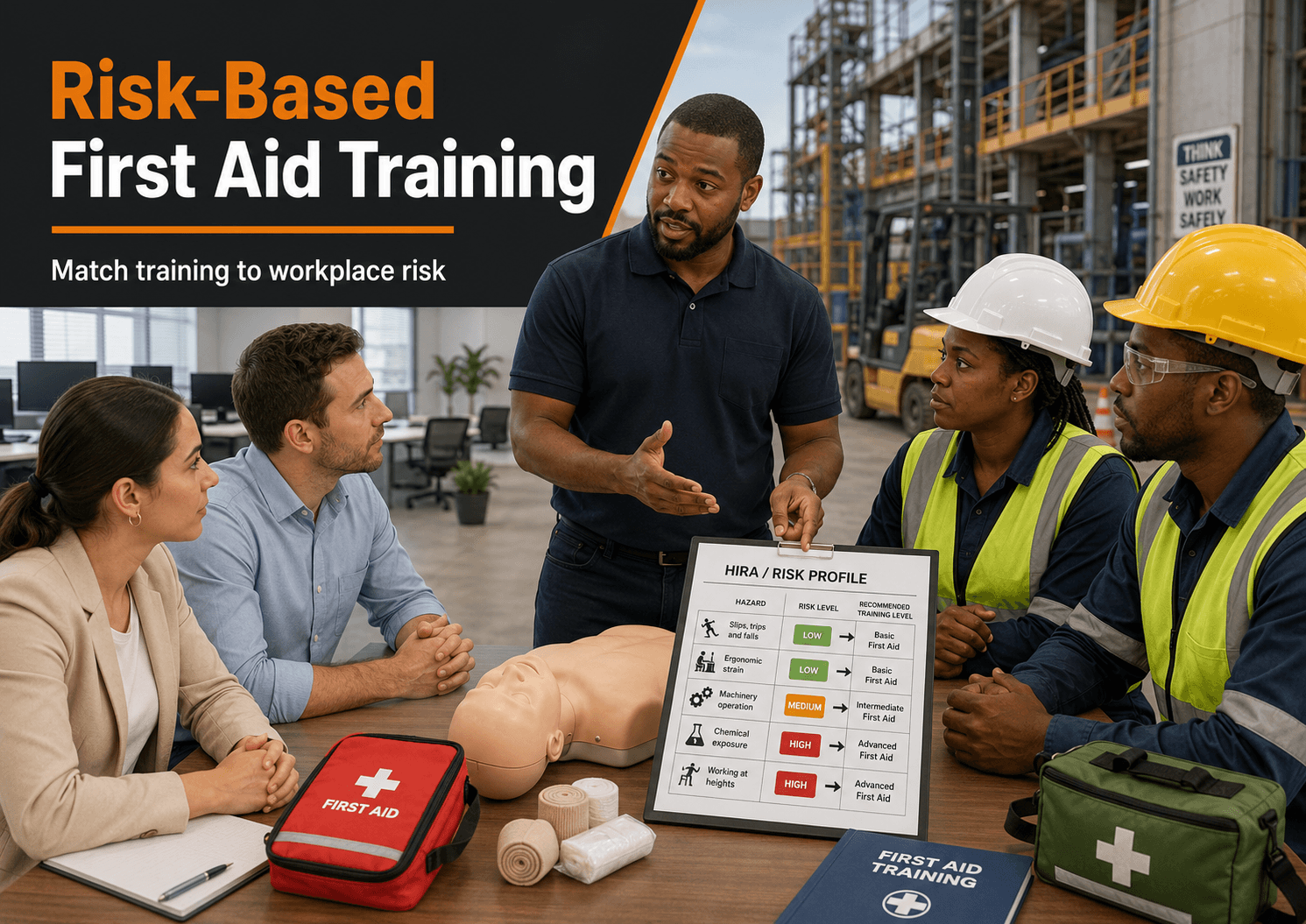

Which level of first aid training does your workplace actually need? There is no single answer that applies to every employer.
A low-risk office, an engineering workshop, a warehouse, a construction site and a remote worksite can all have very different first-aid needs even when they employ the same number of people.
Direct answer: South African workplace first-aid planning should start with the legal requirements in General Safety Regulation 3, but the choice of first-aid competence should also reflect the actual hazards, likely injuries, workplace layout, operating hours and access to professional medical care. The regulations do not create a universal rule that automatically assigns Level 1, Level 2 or Level 3 to a particular industry.
First aid is not one-size-fits-all
The first question is not simply:
“Which first aid course should we book?”
The better question is:
“What emergency situations could reasonably occur in our workplace, and what competence do we need available to respond until professional medical help arrives?”
That changes the discussion from buying a course to managing an actual workplace risk.
Start with General Safety Regulation 3
General Safety Regulation 3 sets the basic workplace first-aid requirements.
First-aid box or boxes
Required when more than 5 employees are employed at the workplace.
Trained first aider
Required when more than 10 employees are employed at the workplace.
Where more than 10 employees are employed, the general minimum ratio is:
- Other workplaces: at least one trained first aider for every group of up to 50 employees.
- Shops and offices: at least one trained first aider for every group of up to 100 employees.
These numbers tell you the minimum trained coverage required. They do not, by themselves, tell you what depth of first-aid competence is most appropriate for your workplace.
Related article: How Many First Aiders Does Your Workplace Need?
Why your workplace risk profile matters
Section 8 of the Occupational Health and Safety Act requires employers to provide and maintain, as far as reasonably practicable, a working environment that is safe and without risk to employees.
That duty includes identifying foreseeable hazards and putting suitable controls in place.
First-aid arrangements should form part of that wider risk-management process.
A workplace risk assessment can help identify:
- What kinds of injuries could occur;
- How serious those injuries could be;
- How frequently employees are exposed;
- How many people may be affected;
- How quickly professional medical help can arrive; and
- Whether particular work areas need additional first-aid coverage.
A HIRA does not simply “assign” a first-aid level
This distinction is important.
A Hazard Identification and Risk Assessment can identify the nature and seriousness of foreseeable injuries and therefore help management decide what first-aid competence is appropriate.
But there is no universal legal formula that says:
low risk = Level 1
medium risk = Level 2
high risk = Level 3.
The decision must be based on the actual workplace, the training outcomes of the programme being considered and any additional sector-specific requirements that may apply.
Risk should guide the decision, but employers should avoid turning “risk-based” into another rigid rule that the legislation itself does not create.
Lower-risk workplaces
Many offices, retail environments and similar workplaces have relatively limited physical hazards.
Likely emergencies may include:
- Minor cuts and wounds;
- Slips, trips and falls;
- Fainting;
- Choking;
- Cardiac emergencies;
- Seizures; or
- Other common medical emergencies.
Foundational workplace first-aid competence may be suitable in many such environments, provided the training meets the applicable certification requirements and the workplace risk assessment supports the decision.
The employer should still consider employee numbers, shift coverage, building layout and emergency medical response times.
Manufacturing and engineering environments
Industrial workplaces may expose employees to more serious injury mechanisms.
Examples include:
- Moving machinery;
- Cutting and grinding;
- Crushing injuries;
- Amputations;
- Serious bleeding;
- Burns;
- Electrical injuries;
- Material handling incidents; and
- Chemical exposure.
Where these hazards are present, management should consider whether a basic course provides sufficient practical capability or whether broader first-aid training is justified.
This does not mean that every factory is automatically legally required to use a particular training level. It means the foreseeable injury profile may justify additional competence.
Work at height
Work at height can introduce serious trauma risks, including fractures, head and spinal injuries and suspension-related medical emergencies following a fall-arrest event.
First-aid planning should therefore be coordinated with the workplace fall protection and rescue arrangements.
A trained first aider is not a substitute for a rescue plan, and a rescue team is not a substitute for appropriate first-aid competence. Both functions may be needed.
Chemical and hazardous-substance environments
Where employees may be exposed to hazardous chemicals, the employer should consider the medical consequences identified in the relevant risk assessment and safety data information.
Potential emergencies may include:
- Chemical burns;
- Eye exposure;
- Inhalation;
- Poisoning;
- Respiratory distress; or
- Skin contamination.
First-aid training, emergency equipment and procedures should be appropriate to those foreseeable exposures.
Remote and isolated workplaces
Distance from professional medical assistance can significantly change the first-aid requirement in practical terms.
If an ambulance can reach an office in a city within a relatively short period, the first aider may only need to provide immediate care until handover.
At a remote worksite, farm, mine-related operation or isolated project, the first aider may need to manage an injured person for much longer.
When professional assistance is delayed, employers should consider:
- Broader first-aid competence;
- Additional first-aid equipment;
- Reliable communication;
- Emergency transport arrangements; and
- Clear escalation procedures.
Construction work
Construction sites often combine several hazards at the same time, including work at height, machinery, electricity, manual handling, sharp materials and changing site conditions.
First-aid arrangements should therefore be reviewed as the project develops rather than relying on a once-off decision made at the start of the job.
Related article: First Aid Requirements on Construction Sites: What Contractors Must Provide
Employee numbers do not determine the training level
A common mistake is assuming that a larger workforce automatically requires a more advanced first-aid course.
Employee numbers primarily affect the number of trained first aiders required.
The nature of the risk is what should drive the discussion about the depth of first-aid competence.
For example, a 150-person office and a 30-person engineering workshop could have very different first-aid training needs even though the office has five times as many employees.
Shift coverage can be more important than course level
A company may spend money training one employee to an advanced level and still have poor first-aid arrangements if that person only works day shift while production continues at night.
The employer must consider whether trained people are actually available whenever employees are working.
This includes:
- Day and night shifts;
- Weekend work;
- Overtime;
- Leave;
- Sick leave;
- Training days; and
- Employees moving between sites.
Related article: Does Every Shift Need Its Own Trained First Aider?
Multiple buildings and departments
A headcount-based calculation can also hide practical response problems.
If the workplace has several buildings, floors, production areas or remote departments, one first aider may be too far away to respond quickly even where the numerical ratio appears adequate.
The first-aid plan should therefore consider:
- Physical distance;
- Access control;
- Travel time between areas;
- Different hazards in different departments; and
- Whether each area has realistic access to trained help.
What about First Aid Level 1, Level 2 and Level 3?
These terms are commonly used to describe progressively broader first-aid training.
However, employers should avoid using the labels alone as a compliance shortcut.
The important questions are:
- What does the course actually teach?
- What competence is assessed?
- Is the certification appropriate for workplace first-aid purposes?
- Does the course address the injuries foreseeable in our workplace?
- Will enough trained people be available during all operating periods?
Related article: First Aid Level 1 vs Level 2 vs Level 3: Which Does Your Workplace Need?
A practical risk-based decision process
Use the following sequence:
- Confirm your legal first-aid obligations.
- Determine employee numbers and operating shifts.
- Review the workplace HIRA and foreseeable injuries.
- Consider how quickly professional medical help can reach the workplace.
- Identify whether different departments have different hazards.
- Select first-aid training with outcomes appropriate to those risks.
- Train enough people to maintain real coverage.
- Track validity, expiry and backup coverage.
This is much stronger than simply asking a training provider for “the minimum course”.
Document why you selected the training
The employer should be able to explain why the chosen first-aid arrangements are suitable.
A practical record could include:
- The workplace HIRA;
- Employee and shift numbers;
- First-aid coverage calculations;
- Course outcomes considered;
- Current first-aider certificates;
- Expiry dates; and
- Any additional site-specific emergency arrangements.
This creates a defensible connection between workplace risk and the training provided.
Use your OHS training matrix
Your training matrix should identify:
- Each first aider;
- The course or competence held;
- Department;
- Shift;
- Certificate date;
- Expiry or renewal date; and
- Backup coverage.
That allows HR and OHS management to see upcoming gaps before they become a compliance problem.
Related article: How to Build an OHS Training Matrix That Keeps Your Workplace Compliant
Common mistakes employers make
Choosing a course based only on industry
“We are a factory, therefore we need Level 2” is too simplistic. Actual hazards and foreseeable injuries matter.
Choosing the cheapest course automatically
A lower-cost course may not provide the competence your risk profile requires.
Choosing the highest course automatically
More training is not a substitute for proper numbers, shift coverage, equipment and emergency planning.
Ignoring response time
A remote workplace may need more robust arrangements because professional medical help takes longer to arrive.
Ignoring staff turnover
Your first-aid system can become inadequate overnight if a key first aider resigns, transfers or moves to another shift.
Frequently Asked Questions
Does the OHS Act prescribe First Aid Level 1, Level 2 or Level 3 for specific industries?
There is no universal rule in General Safety Regulation 3 assigning a particular first-aid level to every industry. Employers should select suitable competence based on applicable legal requirements, foreseeable workplace injuries and the risk profile.
Can an office use basic first-aid training?
Often, yes, where the workplace is genuinely lower risk and the training provides suitable workplace first-aid competence. The employer should still confirm this against the actual hazards and emergency arrangements.
Does a high-risk workplace automatically require Level 3?
Not automatically under GSR 3. A higher-risk or remote workplace may justify broader first-aid competence, but the decision should be supported by the actual risk assessment and any other requirements applicable to the activity.
Who should decide what first-aid training we need?
The employer remains responsible for the workplace arrangements. The decision should be based on the risk assessment and legal requirements, with appropriate input from OHS, operations and a competent training provider where necessary.
Is the number of first aiders based on risk?
The basic numerical ratios are established by General Safety Regulation 3. Risk, shifts, workplace layout and accessibility may justify additional coverage beyond that basic minimum.
Should first-aid training be reviewed when the workplace changes?
Yes. Changes to machinery, chemicals, processes, employee numbers, shifts, buildings or emergency response times may alter the workplace’s first-aid needs and should trigger a review.
Is your first-aid training matched to your actual workplace risk?
Altra Medical Productions can help you review your employee numbers, shifts, workplace hazards and current first-aid certificates to identify gaps in your first-aid arrangements.
We can then help you select suitable first-aid training and build a practical training matrix that keeps your coverage current.
Related articles and services
- First Aid Training
- How Many First Aiders Does Your Workplace Need?
- First Aid Level 1 vs Level 2 vs Level 3
- Does Every Shift Need Its Own Trained First Aider?
- How to Build an OHS Training Matrix
- What Is a HIRA?
Legal references
- Occupational Health and Safety Act 85 of 1993 — particularly Section 8
- General Safety Regulation 3
This article provides general information. First-aid arrangements should be based on current legislation, the specific workplace risk profile and any additional legal or sector requirements that apply.
altra
0 Comments