
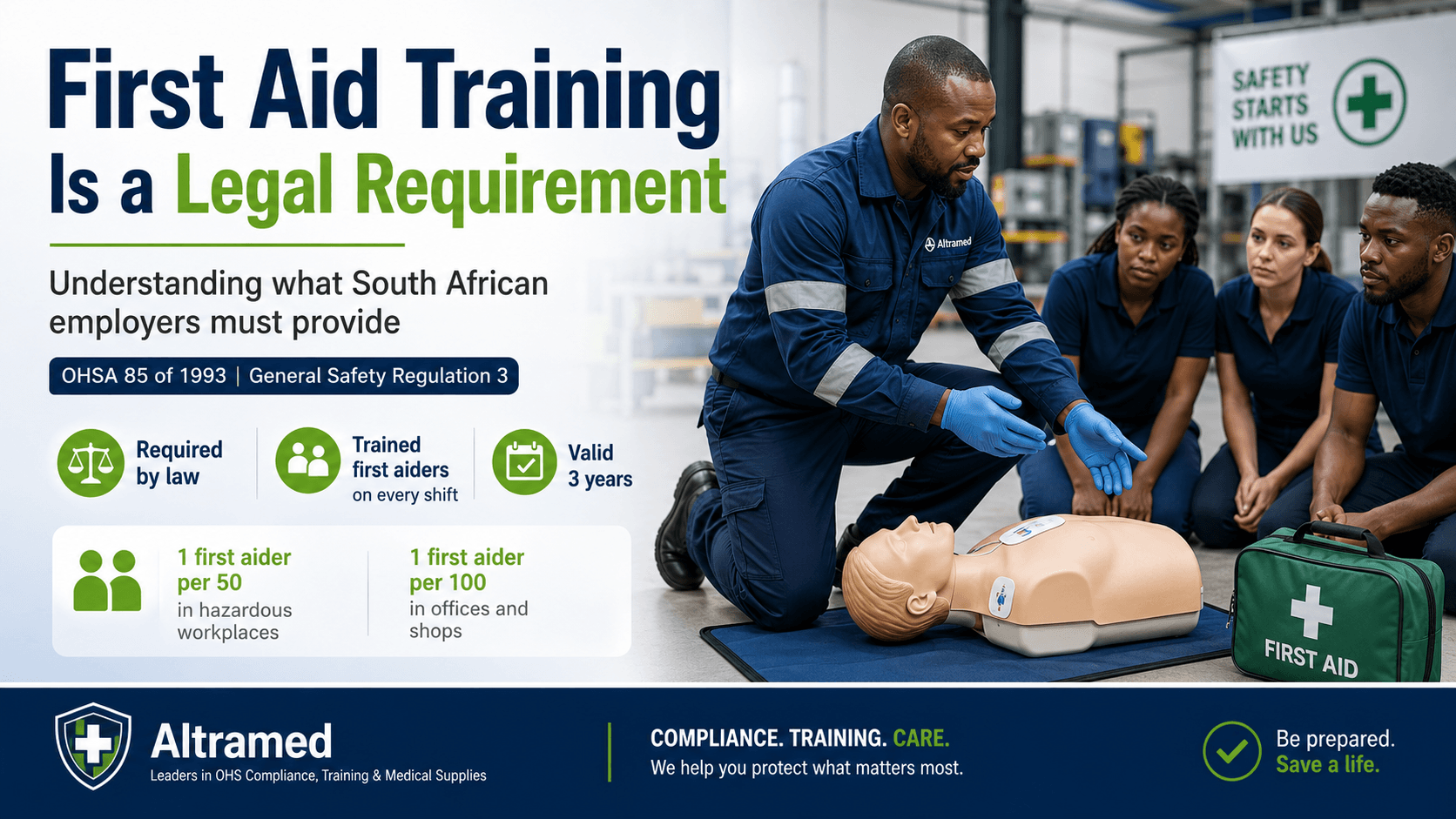

Why first aid training is a legal obligation, not an optional benefit
Every South African employer with more than five employees is legally required to have trained first aiders available during all working hours. This obligation flows directly from the Occupational Health and Safety Act 85 of 1993 (OHSA) and is given specific force by General Safety Regulation 3, which sets out the minimum number of trained first aiders required based on the size and nature of your workforce.
The question most employers and HR managers face is not whether to train first aiders — the law is clear on that — but which level of first aid training applies to their workplace. Getting this wrong in either direction carries real risk: training to a level lower than required leaves you non-compliant and liable during a Department of Employment and Labour (DoEL) inspection; over-training every employee when a lower level suffices wastes training budget that could be better allocated across your broader OHS programme.
This post sets out the framework for making the right decision for your specific workplace context.
The three levels of accredited first aid training in South Africa
South African first aid training is structured into three progressive levels, each recognised by the Department of Labour (DoL) and accredited with the Health and Welfare SETA (HWSETA). The levels build on one another — a learner certified at Level 2 has already achieved Level 1 competency, and a Level 3 first aider carries all prior level competencies.
All three levels are aligned to SAQA Unit Standard 120496 and its progressive equivalents within the HWSETA framework, and training must be delivered by a provider accredited with both the DoL and the HWSETA to be legally valid. A certificate from an unaccredited provider will not satisfy your obligations under General Safety Regulation 3 and will not protect you during a DoEL inspection.
Altramed is accredited with HWSETA and the Department of Labour to deliver all three first aid levels — including a combined Skills Programme that takes learners from Level 1 through to Level 3. View our first aid training courses here.
General Safety Regulation 3: the ratios that determine what you need
General Safety Regulation 3, promulgated under OHSA 85 of 1993, sets the minimum first aider ratios that every employer must meet:
- One trained first aider for every 50 employees in any workplace classified as hazardous.
- One trained first aider for every 100 employees in offices and shops.
These ratios apply per shift, not per total headcount. If your operation runs multiple shifts, you must have a qualified first aider present and available during each shift — not simply employed by the company. A first aider who works the day shift does not satisfy your Regulation 3 obligation for the night shift.
The regulation also requires that first aiders be available during all working hours. This means your first aider coverage plan must account for annual leave, sick leave and shift rotation — typically requiring you to train more first aiders than the minimum ratio strictly demands.
Which first aid level does your workplace need?
The appropriate level of first aid training for your workplace depends on three factors: the nature of the hazards your employees are exposed to, the size of your workforce, and your industry sector. Here is how to apply these factors in practice.
First Aid Level 1
Level 1 is the entry-level qualification and is appropriate for lower-risk environments where employees are unlikely to encounter serious or complex medical emergencies as a direct result of their work activities. It satisfies the Regulation 3 first aider ratio requirement for offices, retail environments and shops where the primary risk profile is relatively low.
It is also the mandatory starting point for any learner who intends to progress to Level 2 or Level 3 — you cannot enter the higher levels without Level 1 certification.
First Aid Level 2
Level 2 is suited to workplaces with a moderate-to-elevated risk profile — environments where employees work with machinery, chemicals, physical loads or in conditions that increase the probability of more serious injuries. Manufacturing plants, construction sites with office-based support staff, logistics operations and light industrial facilities typically fall into this category.
Many employers in sectors such as warehousing, food processing and facilities management find that Level 2 provides the appropriate balance between competency and cost — sufficient to manage a broader range of incidents than Level 1, without the full clinical depth that Level 3 demands.
First Aid Level 3
Level 3 is the highest level of workplace first aid training available under the HWSETA framework and is required in high-risk environments where employees face a significant probability of severe or life-threatening injury as a direct consequence of their work activities. Construction sites, mining support operations, heavy manufacturing, chemical handling environments, and workplaces conducting work at heights or in confined spaces typically require Level 3 trained first aiders.
The Construction Regulations 2014 — promulgated under OHSA 85 of 1993 — require that first aid equipment and trained first aiders appropriate to the risk on site be available at all times. For most active construction sites, the risk profile warrants Level 3 as the minimum acceptable standard.
Level 3 is also the appropriate qualification if you intend to appoint someone in a dedicated occupational health or first aid officer role, or if you are building a first aid team that needs to manage complex multi-casualty incidents on a large site.
The first aid skills programme: combining all three levels
Altramed offers a structured Skills Programme that takes learners through all three first aid levels in a single, sequenced training journey. This is recognised by HWSETA as a formal Skills Programme and carries value on a learner’s National Qualifications Framework (NQF) record.
For employers, the Skills Programme approach offers two practical advantages. First, it eliminates the need to re-enrol employees for each level individually, reducing total training days and logistical overhead. Second, it produces first aiders qualified to Level 3 — capable of managing the full range of workplace emergencies — while the HWSETA Skills Programme designation allows the training spend to be claimed against your Skills Development Levy (SDL) obligations, subject to your SETA’s submission and approval processes.
This makes the combined Skills Programme particularly attractive for companies managing their B-BBEE scorecard under the Skills Development element, or for employers looking to maximise the return on training expenditure across their OHS budget.
How long does first aid certification last?
First aid certificates issued under the HWSETA and DoL framework are valid for three years from the date of assessment. After three years, first aiders must complete a re-certification course to maintain their valid status. An expired first aid certificate does not satisfy your General Safety Regulation 3 obligation — an inspector will treat an expired certificate the same as no certificate.
Tracking certificate expiry dates across your workforce is an essential part of your OHS compliance administration. Altramed recommends building first aid certificate renewal into your annual OHS calendar well ahead of expiry dates, particularly given that re-certification courses require scheduling and cannot always be arranged at short notice.
First aid kits: a separate but related obligation
Trained first aiders are only half of your Regulation 3 obligation. The regulation also specifies the minimum contents and quantities of first aid kits required in the workplace, based on the number of employees. Your first aid kits must be adequately stocked, maintained and accessible at all times — and your appointed first aiders should be the persons responsible for inspecting and restocking them.
First aid kit requirements should form part of your broader workplace hazard identification and risk assessment (HIRA) process. View Altramed’s HIRA and OHS consulting services here.
Fire safety and first aid: a combined compliance approach
OHSA requires employers to address both medical emergency response and fire emergency response in their workplace safety structures. Most DoEL inspectors will check both your first aider appointments and your fire-fighting training records during a workplace inspection — they are treated as complementary obligations, not separate ones.
For fire equipment supply, servicing, fire risk assessments and SANS 10400-T compliant fire installations, contact the fire compliance specialists at Altrafire — our recommended partner for the fire protection side of your OHS compliance programme.
Frequently asked questions about first aid training levels in South Africa
Does my receptionist or office administrator count as a first aider if she has a Level 1 certificate?
Yes, provided the certificate was issued by a DoL- and HWSETA-accredited training provider, is still within its three-year validity period, and the employee is present and available during working hours. The regulation requires availability — a first aider who is frequently off-site or whose role takes them away from the main work area may not practically satisfy the requirement even if technically certified.
Can I appoint one person as both the health and safety representative and the first aider?
Yes. There is no legislative prohibition on a single employee holding both appointments simultaneously, provided they have the relevant certification for each role. In smaller workplaces this is common practice. However, as the business grows, the combined workload and potential conflict of duties during an incident make it advisable to separate the roles.
What happens if my first aider resigns or goes on extended leave?
Your Regulation 3 obligation does not pause because a first aider has left the business or is absent. You are required to maintain the minimum ratio during all working hours. If a trained first aider departs or is unavailable for an extended period, you must either arrange interim coverage — for example, an employee from another department who holds a valid certificate — or accelerate training of a replacement. Planning for this contingency is why Altramed recommends training more first aiders than the strict minimum ratio requires.
Is online first aid training acceptable for DoL compliance?
No. First aid training under the South African DoL and HWSETA framework requires in-person, practical assessment. The competencies tested — CPR, patient management, bandaging, emergency scene control — cannot be adequately assessed through an online-only format. Any certificate issued purely on the basis of an online course will not satisfy your General Safety Regulation 3 obligation.
Can first aid training spend be claimed against our Skills Development Levy?
Yes, subject to your SETA’s annual submission process and approval. First aid training delivered through a HWSETA-accredited provider and structured as a formal Skills Programme qualifies for SDL claim purposes under the Skills Development Act. Your HR or payroll team should submit the relevant Workplace Skills Plan (WSP) and Annual Training Report (ATR) to your SETA to capture this spend. Altramed can assist with the required documentation.
Book accredited first aid training with Altramed
Altramed has delivered accredited first aid training to South African workplaces across Gauteng and nationally since 1997. We are registered with the Department of Labour and accredited with HWSETA to deliver First Aid Levels 1, 2 and 3 as standalone courses and as a combined Skills Programme.
Whether you need to meet your Regulation 3 ratios for the first time, re-certify an existing team, or build a full first aid Skills Programme that works for your SDL obligations — we can structure a training plan around your operational requirements and site schedule.
Call 086 111 1504 or visit www.altramed.co.za to discuss your first aid training requirements.

0 Comments