

Why the distinction matters legally and practically
Fall prevention and fall arrest are two distinct engineering and procedural concepts — and confusing them is one of the most common and costly mistakes made by South African employers managing work at heights. Treating them as interchangeable leads to the wrong equipment being purchased, the wrong training being booked, and — critically — a fall protection approach that does not satisfy the requirements of the Occupational Health and Safety Act 85 of 1993 (OHSA) or the Construction Regulations 2014.
Falls remain the leading cause of fatal injury in the South African construction and industrial sectors. A significant number of those fatalities occur in workplaces where some form of fall protection was in place — but where the wrong type was applied to the task, or where the hierarchy of controls required by law was not followed. Understanding the difference between fall prevention and fall arrest is therefore not a technical nicety; it is a legal obligation and a matter of life and death.
The hierarchy of fall protection under the OHS act.
Before examining fall prevention and fall arrest individually, it is essential to understand that South African law does not treat them as equal alternatives between which an employer may freely choose. OHSA 85 of 1993, read with the Construction Regulations 2014, establishes a clear hierarchy of controls for work at heights — and that hierarchy must be followed in sequence, not skipped over for convenience or cost.
The hierarchy works as follows:
- Avoid work at height entirely where it is reasonably practicable to do so — for example, by using extended-reach tools or prefabricating components at ground level.
- Prevent falls where work at height cannot be avoided — by working from an existing safe place or using equipment that provides edge protection and eliminates the possibility of a fall.
- Minimise the distance and consequences of a fall where prevention is not reasonably practicable — using fall arrest equipment that arrests a fall in progress and limits the forces experienced by the worker.
- Take additional steps — training, information, supervision and safe systems of work — where residual risk of a fall still remains after the above measures have been applied.
This hierarchy has a critical implication: fall arrest is not a first resort. An employer who goes straight to fall arrest harnesses and lanyards without first establishing whether fall prevention measures are reasonably practicable has not followed the OHSA-required approach — regardless of how good the harness equipment is.
What is fall prevention?
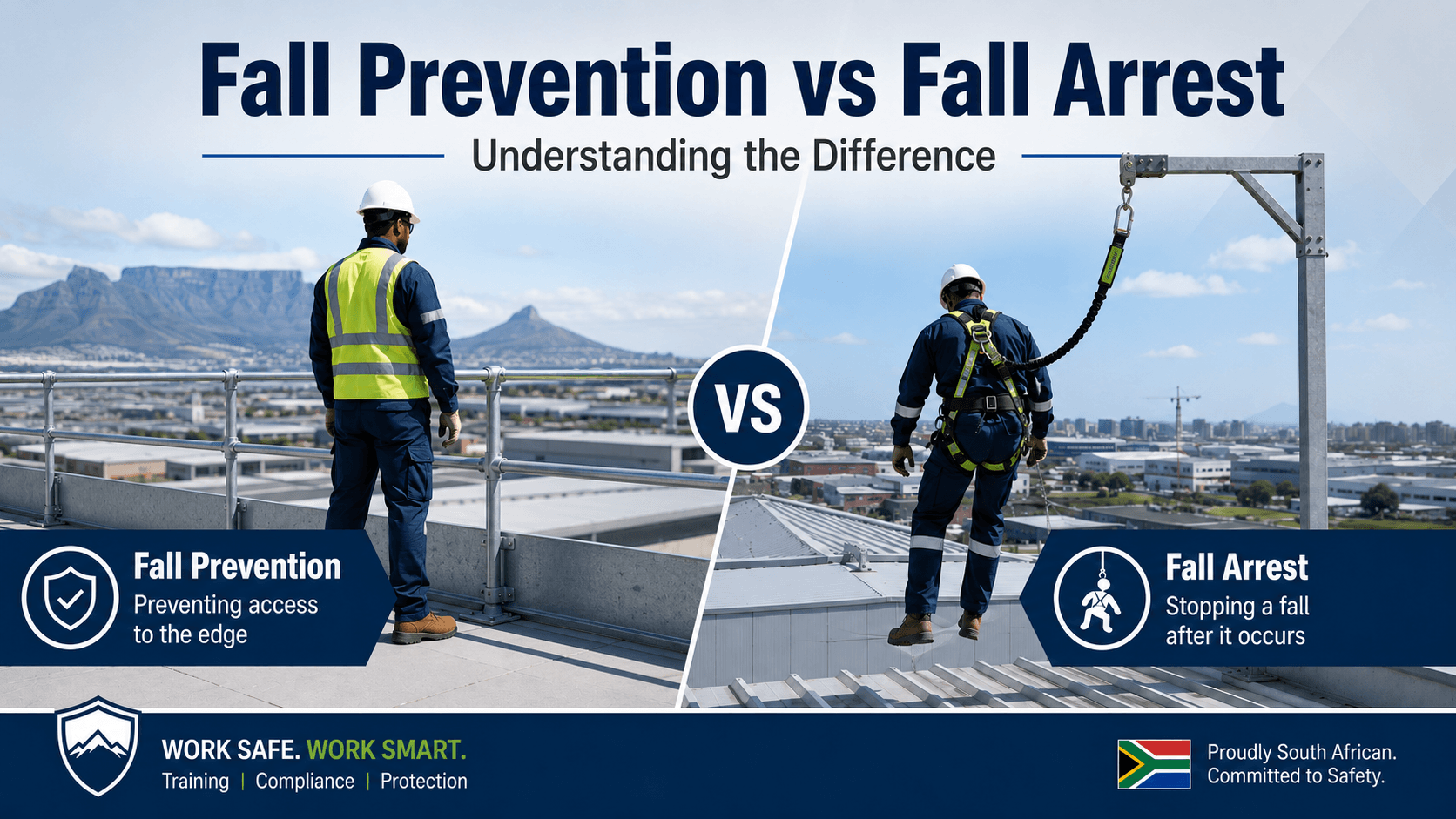
Fall prevention refers to any measure that eliminates the possibility of a fall occurring in the first place. The defining characteristic of a fall prevention system is that a worker physically cannot fall — they are prevented from reaching or entering a zone where a fall is possible, or the work area itself is fully enclosed and protected.
Fall prevention measures include physical guardrails and barriers at open edges, fully enclosed working platforms with standard edge protection, safety nets positioned to prevent access to fall zones, and restraint systems — where a worker is tethered in such a way that they cannot physically reach the edge from which they could fall. A restraint system is a fall prevention system, not a fall arrest system, because it prevents the fall from happening rather than arresting it after it has begun.
The key operational distinction is this: in a fall prevention system, the anchor point, lanyard and harness configuration is set up specifically so that the worker’s range of movement physically cannot bring them to an unprotected edge. If the system allows a worker to reach the edge — even if it would catch them in the event of a fall — it is no longer operating as fall prevention. It has become fall arrest.
Fall prevention is the preferred and legally prioritised approach precisely because it removes the fall energy from the equation entirely. No fall energy means no arrest force, no shock load on anchor points or structural elements, and no suspended worker requiring rescue.
What is fall arrest?
Fall arrest refers to a system designed to catch a worker who has already begun to fall — to arrest the fall in progress and limit the forces applied to the worker’s body to a level that is survivable without serious injury. Fall arrest systems do not prevent the fall from starting; they control its consequences.
A typical fall arrest system consists of a full-body harness, a connecting lanyard (which may incorporate an energy absorber), and an anchor point rated to withstand the dynamic loads generated during a fall arrest event. The energy absorber is a critical component — without it, the sudden deceleration of a fall arrest event generates forces on the worker’s body that can be fatal even when the system performs as designed.
Because fall arrest systems permit a fall to begin before activating, they introduce a range of additional design and management requirements that fall prevention systems do not. The most significant of these is free fall distance — the vertical distance a worker travels before the arrest system begins to decelerate them. Free fall must be minimised, as it directly determines the arrest force. Employers and competent persons designing a fall arrest system must calculate free fall distance carefully and ensure it does not result in the worker striking a lower level, structure or obstruction before the system arrests the fall.
Fall arrest systems also mandate a rescue plan. A worker suspended in a harness after a fall arrest event cannot simply be left hanging. Suspension trauma — also known as harness-induced pathology — can become life-threatening within minutes in an upright suspended position. Any workplace where fall arrest systems are used must have a documented, practiced rescue plan and the competent persons needed to execute it.
The OHS act and Construction Regulations 2014 requirements
The Construction Regulations 2014, promulgated under OHSA 85 of 1993, are the primary regulatory instrument governing work at heights in the South African construction environment. Construction Regulation 10 requires every contractor who carries out construction work where persons may fall to have a documented fall protection plan in place before work commences.
The fall protection plan must be developed by a competent person — specifically a Fall Protection Planner, who holds the qualification aligned to SAQA Unit Standard 229994 — and must address the specific fall risks on the site, the controls to be applied in the hierarchy order described above, the PPE to be issued and inspected, and the rescue arrangements in place for fall arrest scenarios.
Construction Regulation 10 does not allow an employer to simply decide that fall arrest harnesses will be issued and leave it at that. The fall protection plan must demonstrate that fall prevention has been considered and applied where reasonably practicable, and that fall arrest has been specified only for those tasks and locations where prevention is not achievable. The plan must be site-specific, reviewed when conditions change, and available for inspection.
Training requirements: which qualification applies to which role?
Altramed’s work at heights training pathway is structured to address the full hierarchy of fall protection — from fall prevention through to fall arrest rescue — with each qualification aligned to a specific role and level of responsibility on site.
Fall Prevention (FP) — 1 day is the entry-level work at heights qualification, aligned to the Construction Regulations 2014 and OHSA 85 of 1993. It is designed for workers who perform work at heights where fall prevention measures — guardrails, enclosed platforms, restraint systems — are the primary control in place. This qualification is appropriate for the majority of workers who work at height under properly controlled conditions.
Fall Arrest Level 1 (FA) — SAQA US 229998, 2 days is required for workers who operate in environments where fall arrest systems are the specified control — where fall prevention is not reasonably practicable for the task being performed. This qualification equips workers to correctly don and inspect a full-body harness, connect to approved anchor points, and understand the limitations and rescue implications of working in a fall arrest environment.
Fall Arrest Rescue (FAR) — SAQA US 229995, 3 days addresses the rescue obligation that fall arrest environments create. Every fall arrest scenario requires a competent rescue capability on site. This qualification is for designated rescue-capable team members who must be able to safely retrieve a suspended worker within the time window before suspension trauma becomes life-threatening.
Fall Protection Planner (FPP) — SAQA US 229994, 3 days is the qualification required for the competent person responsible for developing and signing off the Construction Regulation 10 fall protection plan. The FPP must understand the full hierarchy of controls, be able to assess site-specific risks, specify appropriate systems for each task and location, and document the plan to the standard the regulations require.
All Altramed work at heights training is accredited with the Services SETA (SSETA) and recognised by the Institute for Work at Height (IWH) Professional Body — the two bodies whose accreditation is required for work at heights training to carry legal standing in South Africa. View Altramed’s full work at heights training offering here.
PPE: fall restraint vs fall arrest equipment
The fall prevention vs fall arrest distinction flows directly into PPE selection — and this is where many employers make costly errors. Fall restraint equipment (used in fall prevention) and fall arrest equipment are not interchangeable. They are designed to different load specifications and must not be substituted for one another.
Restraint lanyards are designed for static or low-load applications where the system is preventing the worker from reaching the fall zone. They are not designed to withstand the dynamic shock load of a full fall arrest event. Using a restraint lanyard in a fall arrest configuration is a potentially fatal misapplication of equipment. Similarly, the anchor points specified for restraint systems are rated to different loads than those required for fall arrest — which must withstand the forces generated during a dynamic fall.
All PPE used in fall protection applications in South Africa must comply with the relevant SANS standards. Anchor points must be appropriate for their application, inspected regularly by a competent person, and documented in the fall protection plan. Equipment that is visually undamaged may still fail inspection if it has been shock-loaded in a previous fall arrest event — a fact that is frequently overlooked on busy construction sites.
Anchor points: the critical link in any fall protection system
Whether fall prevention or fall arrest is the specified control, the integrity of the anchor point is the most critical single element in the system. An anchor point that fails under load negates every other element of the fall protection system — the harness, the lanyard, the training and the plan.
Anchor points used in fall arrest applications must be capable of withstanding the dynamic loads generated during a fall arrest event — loads that are significantly higher than the static weight of the worker. Anchor points for fall arrest must be designed, installed and inspected by competent persons holding the appropriate IWH-recognised qualifications. Altramed offers anchor point selection and testing training, recognised by the IWH Professional Body, for WAH professionals who need to assess and document anchor point suitability on their sites. Learn more about Altramed’s fall protection plan services.
Frequently asked questions about fall prevention and fall arrest
Can I use a fall arrest harness as a restraint system?
The harness itself can be worn in both applications, but the lanyard, anchor point and system configuration must be appropriate for the specific application. A fall arrest lanyard with energy absorber must not be used as a restraint lanyard — it is too long and will allow the worker to reach the fall zone before the restraint is effective. The system must be designed as either restraint or fall arrest from the outset, with equipment matched to the intended function.
Does every worker on a construction site need a Fall Arrest qualification?
Not necessarily. Workers who work at height under fall prevention conditions — on fully enclosed scaffolding with standard guardrails, for example — require fall prevention training but not fall arrest training. Fall arrest training is required for workers whose tasks take them into environments where fall arrest is the specified control and where they will be connecting to and operating within a fall arrest system. The fall protection plan for the site must specify which workers require which level of training.
Who is responsible for ensuring the fall protection plan is in place?
The contractor responsible for the construction work bears the primary obligation under Construction Regulation 10. The plan must be developed by a qualified Fall Protection Planner (SAQA US 229994) before work commences. The principal contractor on a multi-contractor site is responsible for ensuring that all contractors on site have fall protection plans in place and that those plans are co-ordinated where work areas overlap.
How often must fall arrest equipment be inspected?
All personal fall protection equipment must be inspected before each use by the user, and at regular intervals by a competent person — with the frequency determined by the risk assessment and conditions of use. Equipment that has been involved in a fall arrest event must be removed from service immediately, regardless of its apparent condition, and inspected by a competent person before any return to use. In practice, equipment that has arrested a real fall is almost always retired from service.
Is a fall protection plan required for maintenance work on an existing building?
Yes, where that maintenance work constitutes construction work as defined in the Construction Regulations 2014. The definition of construction work is broad and includes maintenance, repair, renovation and alteration work on structures — not only new-build projects. Any employer arranging or undertaking such work must ensure a fall protection plan is in place before work at heights commences.
Book your work at heights training with Altramed
Altramed delivers the full spectrum of work at heights training — Fall Prevention, Fall Arrest Level 1 (SAQA US 229998), Fall Arrest Rescue (SAQA US 229995) and Fall Protection Planner (SAQA US 229994) — from our Gauteng base, with national delivery available. All courses are accredited with the Services SETA (SSETA) and recognised by the IWH Professional Body.
Whether you need to qualify a team of operatives, appoint a Fall Protection Planner for a new project, or establish a rescue-capable WAH team on site — Altramed has the accreditation and the practical expertise to deliver training that satisfies your legal obligations under OHSA 85 of 1993 and the Construction Regulations 2014.
Call 086 111 1504 or visit www.altramed.co.za to book your work at heights training.
For fire equipment, servicing and SANS-compliant fire compliance on your construction or industrial site, contact our partners at www.altrafire.co.za.

0 Comments