


What is the Occupational Health and Safety Act 85 of 1993?
The Occupational Health and Safety Act, Act No. 85 of 1993 (OHSA), is the primary piece of legislation governing workplace health and safety in South Africa. It applies to virtually every employer and every workplace in the country — from a two-person workshop in Boksburg to a multi-site corporate operation in Johannesburg’s CBD.
The Act was promulgated to provide for the health and safety of persons at work and for the health and safety of persons in connection with the use of plant and machinery. It establishes a framework of duties, rights, appointments and penalties that every employer must understand. Ignorance of the Act is not a defence during a Department of Employment and Labour (DoEL) inspection — and the consequences of non-compliance range from improvement notices to criminal prosecution.
This guide breaks down the sections that matter most to employers in practical, plain-language terms, and identifies the training and consulting obligations that flow directly from the Act.
Who does OHSA 85 of 1993 apply to?
The Act applies to all employers and employees, with limited exceptions for mines (covered by the Mine Health and Safety Act), ships at sea, and certain military installations. If you operate a business in South Africa with one or more employees working on your premises or under your control, the Act applies to you — regardless of your industry, size, or corporate structure.
The Act also places obligations on designers, manufacturers, importers and suppliers of plant and machinery sold into South African workplaces, making it broader in scope than simply an employer-versus-employee instrument.
Section 8: the general duty of every employer
Section 8 of OHSA is the cornerstone of the entire Act. It places a duty on every employer to provide and maintain, as far as is reasonably practicable, a working environment that is safe and without risk to the health of employees. This duty covers:
- The provision and maintenance of systems of work and plant that are safe and without risks to health.
- The elimination or mitigation of hazards and potential hazards before resorting to personal protective equipment (PPE).
- Making arrangements for ensuring the safe use, handling, storage and transport of articles and substances.
- Providing information, instruction, training and supervision necessary for employees to carry out their work safely.
- Not permitting any employee to do work that poses a risk to health or safety until the necessary precautions have been taken.
- Ensuring that the workplace is in a condition that does not pose a risk to employees’ health and safety.
The phrase “as far as is reasonably practicable” does not mean employers can take shortcuts. It means the effort and expense required to eliminate a risk must be weighed against the severity and probability of harm — and courts have consistently interpreted this in favour of employee protection.
Section 9: duties to persons other than employees
Section 9 extends the employer’s duty of care beyond the employment relationship. Every employer must conduct the undertaking in such a manner that persons other than employees — contractors, visitors, members of the public, delivery drivers — who may be directly affected by that undertaking are not exposed to hazards to their health or safety. This section is particularly relevant for construction sites, logistics yards, factories and any workplace where non-employees regularly enter the premises.
Section 14: duties of employees
OHSA is not a one-way obligation. Section 14 places corresponding duties on every employee at work. Employees must:
- Take reasonable care for their own health and safety and that of other persons who may be affected by their acts or omissions.
- Co-operate with their employer to enable the employer to comply with the Act’s requirements.
- Carry out lawful orders and obey the health and safety rules and procedures established by the employer.
- Report unsafe or unhealthy situations to their employer or health and safety representative as soon as practicable.
- Report any incident that may affect their health or safety or that of any other person at the workplace.
This section provides the legal basis for disciplining employees who wilfully disregard safety procedures. It also underlines why workplace safety induction and ongoing training are so important — if an employee has not been trained, an employer cannot reasonably rely on section 14 obligations when things go wrong.
Section 24: incident reporting obligations
Section 24 of OHSA requires employers to report certain incidents to the relevant provincial office of the DoEL. The reporting obligation is triggered when:
- An employee dies as a result of an incident at the workplace.
- An employee is injured or becomes ill to such a degree that medical treatment beyond first aid is required — or the employee is likely to be absent from work for more than 14 days.
- An employee sustains a permanent disability.
- An occurrence takes place that could have caused injury, illness or death (a dangerous occurrence).
Reporting must be done as soon as possible and no later than seven days after the incident. This is one of the most commonly missed compliance requirements — particularly among smaller businesses who assume section 24 only applies to fatalities. The obligation to report medically treated injuries is equally binding.
Key regulations made under OHSA 85 of 1993
The Act grants the Minister of Employment and Labour authority to publish subsidiary regulations under section 43. These carry the full force of law and create specific, enforceable obligations. The most commonly applicable for South African businesses are:
General Safety Regulations cover a wide range of workplace hazards including machinery guarding, stacking and storage, and first aid provision. General Safety Regulation 3 specifically determines how many trained first aiders a workplace must have: one per 50 employees in hazardous environments, and one per 100 employees in offices and shops. View Altramed’s HWSETA-accredited first aid training courses.
Construction Regulations 2014 apply to all construction work and introduce specific requirements for fall protection plans (Regulation 10), competent persons for work at heights, temporary suspended platforms (Regulation 17), and mandatory health and safety files.
General Administrative Regulations govern the appointment of health and safety representatives and committees, documentation requirements, and incident reporting procedures.
Driven Machinery Regulations cover the safe installation, use and guarding of machinery across manufacturing, processing and industrial environments.
Physical Agents Regulations (2024) — the most recent addition — govern employer obligations around employee exposure to heat stress, cold stress, noise, vibration, illumination, indoor air quality and occupational non-ionising radiation.
Each set of regulations must be read together with the parent Act. They do not replace section 8’s overarching general duty — they add specificity and measurable standards to it.
Health and safety representatives and committees
OHSA requires employers with more than 20 employees in a workplace to designate health and safety representatives from among non-management employees who regularly work there. Workplaces with two or more health and safety representatives must establish a health and safety committee.
The role is not ceremonial. Health and safety representatives have the right to inspect any part of the workplace, investigate incidents, identify hazards, and make representations to management. Their appointment must be documented, and they must receive appropriate training to carry out their functions. Altramed’s SHE Representative training, aligned to SAQA US 259622, equips newly appointed representatives with the competencies the Act demands. View our full range of accredited OHS courses.
Training obligations under OHSA 85 of 1993
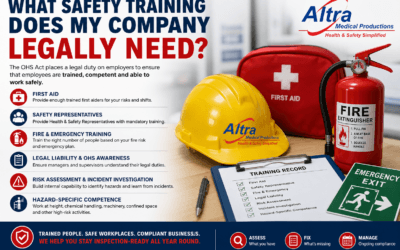
Section 8’s requirement to provide information, instruction, training and supervision creates a legally enforceable obligation to train employees for the specific hazards they face at work. “We told them to be careful” does not satisfy the section 8 standard. Specific training requirements that flow from regulations under the Act include:
First aid: General Safety Regulation 3 requires a minimum number of trained first aiders on site, with training registered with the Department of Labour and HWSETA.
Fire fighting: OHSA, read with SANS 10400-T and applicable municipal by-laws, requires designated employees to be trained in the use of hand-operated fire-fighting equipment. For workplaces managing fire risk across larger facilities, trained fire fighters and appointed emergency coordinators are a further requirement.
Work at heights: The Construction Regulations 2014 require competent persons for all work at height activities. Fall prevention, fall arrest and fall protection planning qualifications must be accredited by the Services SETA (SSETA) and recognised by the Institute for Work at Height (IWH) Professional Body.
Hazard identification and risk assessment (HIRA): Employers must conduct HIRAs, and the personnel involved must be competent to do so — in practice, trained against a recognised standard such as SAQA US 120330.
Altramed holds accreditations from HWSETA, SSETA, the Department of Labour, DHET and the IWH Professional Body, making us one of the few South African providers able to deliver legally compliant training across all of these obligation areas from a single accredited source.
Fire safety: where OHSA meets SANS 10400-T
OHSA’s general duty of care extends directly to fire prevention and emergency preparedness. Employers must assess fire risks in the workplace, appoint trained fire fighters and emergency coordinators, and ensure emergency evacuation procedures are in place and regularly tested — requirements that interact with SANS 10400-T (fire protection in buildings), SANS 10139 (fire detection and alarm systems) and SANS 23601:2010 (emergency escape plan design and display).
For fire equipment supply, servicing, fire risk assessments and SANS-compliant fire installations, contact the fire compliance specialists at Altrafire — Altramed’s sister brand and our recommended partner for everything on the fire protection side.
Consequences of non-compliance with OHSA 85 of 1993
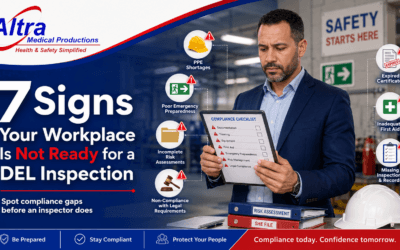
A DoEL inspector may issue a prohibition notice — stopping work immediately — or an improvement notice giving the employer a period to rectify deficiencies. Where a contravention is serious, criminal prosecution can follow, with conviction carrying the risk of a fine and/or imprisonment for the responsible person, which in most cases means a director or owner of the business.
Beyond the criminal exposure, non-compliance creates civil liability. Where an employee is injured in a workplace where the employer has not met their section 8 obligations, claims that extend beyond the COIDA framework become a real risk. The financial and reputational consequences of a serious workplace incident far exceed the cost of getting compliant in the first place.
Building OHSA 85 of 1993 compliance in your workplace: five core actions
- Conduct a documented hazard identification and risk assessment (HIRA) for all workplace activities and review it at minimum annually.
- Implement risk controls in the hierarchy the Act requires: eliminate the hazard first, engineer it out second, use administrative controls third, and resort to PPE only as a last line of defence.
- Ensure all legally required training is completed with accredited providers — first aid, fire fighting and work at heights being the most universally applicable obligations.
- Appoint and train health and safety representatives (mandatory if more than 20 employees) and establish a health and safety committee where required.
- Have documented emergency evacuation plans displayed in accordance with SANS 23601:2010 and conduct regular evacuation drills with written reports.
This is not a once-off exercise. The Act requires ongoing monitoring, regular refresher training and continuous review of your risk assessments. A single audit event does not constitute a compliant OHS management system.
Frequently asked questions about OHSA 85 of 1993
Does OHSA apply to businesses with fewer than five employees?
Yes. OHSA does not set a minimum employee threshold for the application of its core duties under sections 8, 9 and 14. Certain specific regulations — such as the requirement to appoint health and safety representatives — only activate where an employer has more than 20 employees at a single workplace.
Can I use a non-accredited trainer to meet my OHSA training obligations?
For general toolbox talks and internal safety briefings, any competent person can facilitate training. However, where a regulation specifically requires an accredited qualification — such as the first aider ratio under General Safety Regulation 3, or work at heights competencies under the Construction Regulations 2014 — only training delivered by a provider accredited with the relevant SETA or professional body will satisfy the legal requirement. A certificate from a non-accredited provider will not protect you during a DoEL inspection.
How often must a risk assessment be reviewed?
The Act does not specify a single universal review interval, but the Physical Agents Regulations 2024 require exposure risk assessments to be reviewed at least every 24 months, or sooner when conditions change, a reportable incident occurs, or new information becomes available. Best practice — and the standard Altramed recommends to all clients — is annual review of all risk assessments, plus an immediate review after any significant change to the workplace or work processes.
Who bears legal responsibility for OHSA compliance — the HR manager, the safety officer, or the director?
Section 8 places the primary duty squarely on the employer — in practice, the legal entity and the directors or owners who control it. Line managers are typically assigned operational

0 Comments