
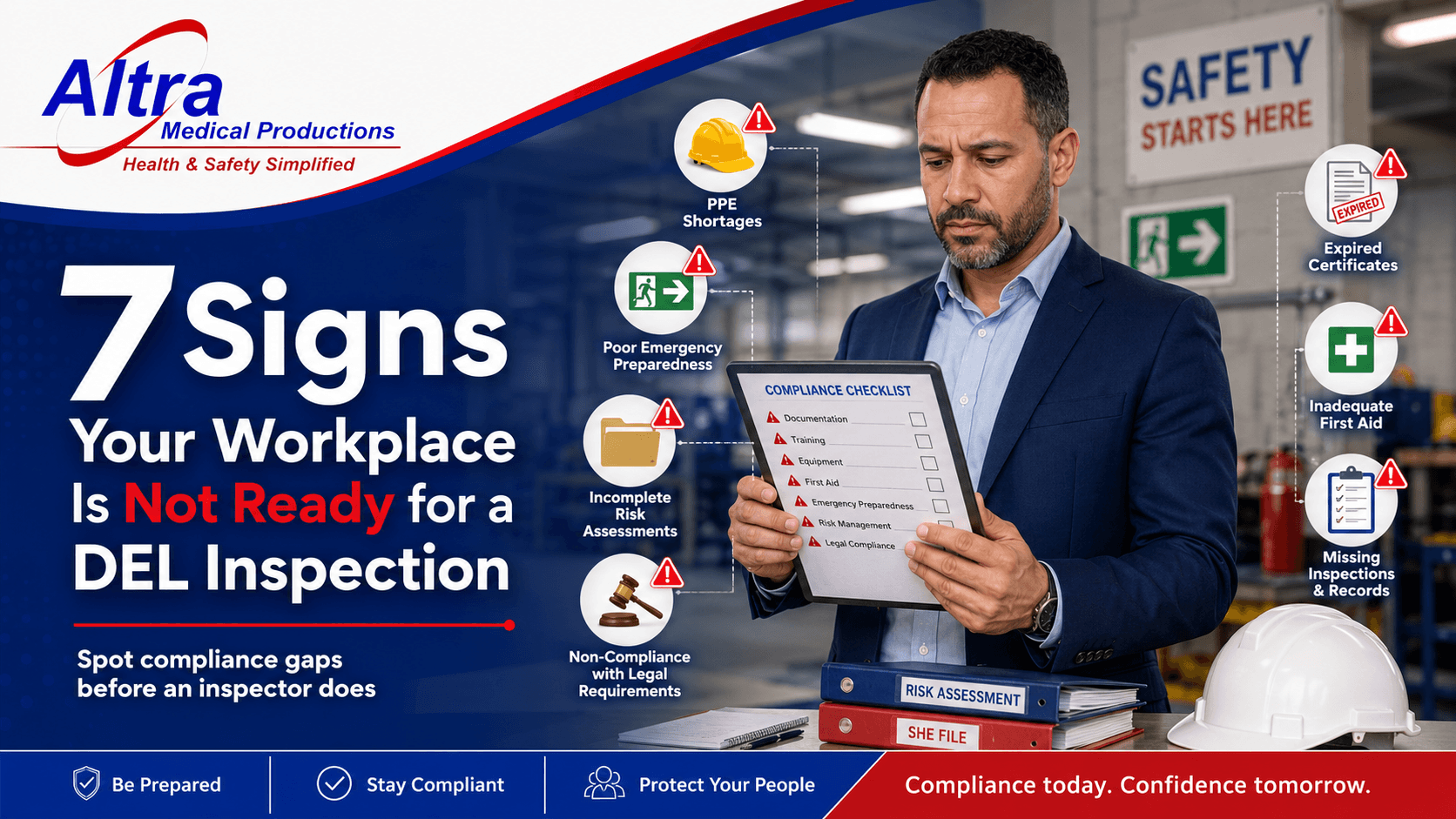

If your business needs several days to “get ready” for a Department of Employment and Labour inspection, that is already a warning sign. OHS compliance should exist in the workplace every day — not only when an inspector is expected.
The Department can inspect workplace conditions, ask employees questions and require relevant records. That means the strongest businesses are not the ones with the thickest files. They are the ones where the documents, the workplace and the way employees actually work all tell the same story.
Direct answer: Your workplace may not be DEL-inspection ready if nobody can explain what is outstanding, training and appointments are out of date, risk assessments no longer match the work, emergency arrangements have not been tested, corrective actions remain open, or management would need to scramble before an inspector arrives.
Inspection readiness is a management test
A DEL inspection is not only a test of your OHS administrator or safety officer. It is a test of whether the business has a functioning management system.
An inspector may enter relevant workplace premises without prior notice, question people and require books, records or other documents relevant to the OHS Act. That is why inspection readiness cannot depend on one person rushing around looking for certificates after the inspector has arrived.
Related article: How to Prepare for a Department of Employment and Labour Safety Inspection
Sign 1: Nobody can tell you what is currently outstanding
Ask a simple question:
“What are our current OHS compliance gaps?”
If the answer is vague, management probably does not have a clear picture of its current compliance status.
A functioning system should make it possible to identify open audit findings, expired or expiring training, missing appointments, outstanding equipment inspections, overdue risk-assessment reviews, emergency-plan issues and corrective actions that have not been closed.
The business does not need to be perfect. It does need to know what is wrong and what is being done about it.
Sign 2: Training certificates are scattered and nobody monitors expiry dates
One first-aid certificate is with HR. Another is in the safety file. A safety representative certificate is in the employee’s email. A manager attended legal-liability training but nobody knows where the record is.
This is a common sign that training is being purchased as individual courses instead of being managed as a compliance system.
A useful training matrix should show who needs training, who has completed it, which shift they work, when the certificate expires and what is still outstanding.
Related article: What Safety Training Does My Company Legally Need in South Africa?
Sign 3: Appointment letters exist, but the appointed people do not know their duties
A signed appointment letter is not the same as a functioning appointment.
Ask one of your appointed people: “What are you responsible for?”
If the person cannot answer, the appointment may exist only on paper.
This is especially important for health and safety representatives, first aiders, incident investigators, risk assessors, managers carrying assigned OHS duties and competent persons appointed under specific regulations.
Sign 4: Your risk assessments no longer match the workplace
Walk through the site with the current risk assessment.
Does it mention the machinery employees actually use? Does it reflect the chemicals currently stored on site? Does it include the contractor activities taking place now? Does it reflect the current shift structure and work methods?
If the workplace has changed but the risk assessment has not, the rest of the safety system may already be based on outdated information.
Related article: What Is a HIRA? Risk Assessment Under OHSA Explained
Sign 5: You have an emergency plan, but nobody has tested it recently
A written emergency plan can look excellent and still fail in practice.
You only discover certain problems when the system is tested — for example, an alarm that cannot be heard, a blocked exit, no warden on night shift, employees going to the wrong assembly point, or nobody knowing who must account for visitors.
If the business cannot remember when the last drill was conducted — or cannot produce the drill report and corrective actions — emergency preparedness may be weaker than management believes.
Sign 6: The same findings appear in every audit or inspection
Repeated findings are one of the clearest signs that the OHS system is not closing the loop.
For example:
January: emergency exit blocked.
March: emergency exit blocked.
June: emergency exit blocked again.
The bigger problem is no longer only the blocked exit. The management system is failing to prevent recurrence.
Every important finding should have a responsible person, target date, immediate control where necessary, corrective action and evidence of close-out.
Sign 7: You would need a few days to “prepare” if DEL arrived
This is perhaps the most useful test of all.
Imagine somebody tells you:
“A Department of Employment and Labour inspector will be here in one hour.”
If the response is calm and the current records can be produced quickly, that is a good sign.
If the response is to urgently update appointments, find certificates, print risk assessments and clear obvious hazards, the workplace is not inspection-ready.
If you need a week to prepare for an OHS inspection, you are probably not compliant today.
What an inspection-ready workplace looks like
| Weak system | Inspection-ready system |
|---|---|
| Documents scattered across departments | Current records can be produced quickly |
| Training booked only when certificates expire | Training matrix actively monitors competence and expiry |
| Appointment letters filed and forgotten | Appointed people understand and perform their duties |
| Generic or outdated risk assessments | Assessments reflect actual work and current hazards |
| Emergency plan exists only on paper | Emergency arrangements are communicated and tested |
| Audit findings remain open | Corrective actions are assigned and closed |
| Compliance checked before inspections | Compliance monitored throughout the year |
Why these warning signs matter
Section 29 of the OHS Act gives inspectors broad inspection powers. They may enter relevant premises without prior notice at reasonable times, question people and require relevant records to be produced.
That means an inspector can compare the records with what employees say and what is visible on site.
The workplace, the employees and the records should support one another.
What should you do if you recognise several of these signs?
Start by establishing your actual compliance position.
- Review the physical workplace.
- Review the applicable OHS requirements.
- Compare current records against actual conditions.
- Identify high-risk and legal gaps first.
- Assign corrective actions.
- Fix urgent issues.
- Build a system to prevent the same gaps from returning.
The goal is not to create a thicker safety file.
The goal is to know: what is required, what is compliant, what is missing, who is responsible and when the gap will be closed.
Frequently asked questions
How do I know if my workplace is ready for a DEL inspection?
You should be able to explain your main workplace risks, produce current OHS records, show that required appointments and training are in place, demonstrate that inspections and emergency arrangements are functioning, and identify any open corrective actions.
Does DEL have to give notice before an OHS inspection?
No. Section 29 of the OHS Act allows an inspector to enter relevant workplace premises at reasonable times without previous notice.
Can an inspector speak directly to employees?
Yes. Inspectors have powers to question people on matters relating to the OHS Act.
Can an inspector ask for OHS records?
Yes. Inspectors may require relevant books, records and other documents to be produced and may examine or copy them.
What is the biggest sign that a workplace is not inspection-ready?
If management needs several days to collect records, update appointments, renew training or correct obvious hazards before an inspection, the compliance system is probably reactive rather than continuously maintained.
Does a good safety file mean we are compliant?
No. A safety file can provide useful evidence, but actual workplace conditions, employee competence, inspections, emergency arrangements and corrective actions must also support the documentation.
Would you need to scramble if DEL arrived tomorrow?
Altra Medical Productions can review your workplace, OHS documentation, training, appointments and emergency arrangements to show you where your real compliance gaps are.
You get a clear picture of what is compliant, what needs attention and what should be prioritised — before an inspector finds it for you.
Related articles and services
- OHS Legal Compliance Audit
- How to Prepare for a Department of Employment and Labour Safety Inspection
- How Do I Know If My Workplace Is OHS Compliant in South Africa?
- What Safety Training Does My Company Legally Need in South Africa?
- Does Every Shift Need Its Own Trained First Aider?
- Does Appointing a Safety Officer Transfer Management’s Legal Liability?
Legal references
- Occupational Health and Safety Act 85 of 1993 — particularly Section 29
- Regulations applicable to the specific hazards and activities of the workplace
This article provides general information and does not replace a workplace-specific OHS legal compliance assessment.


0 Comments