
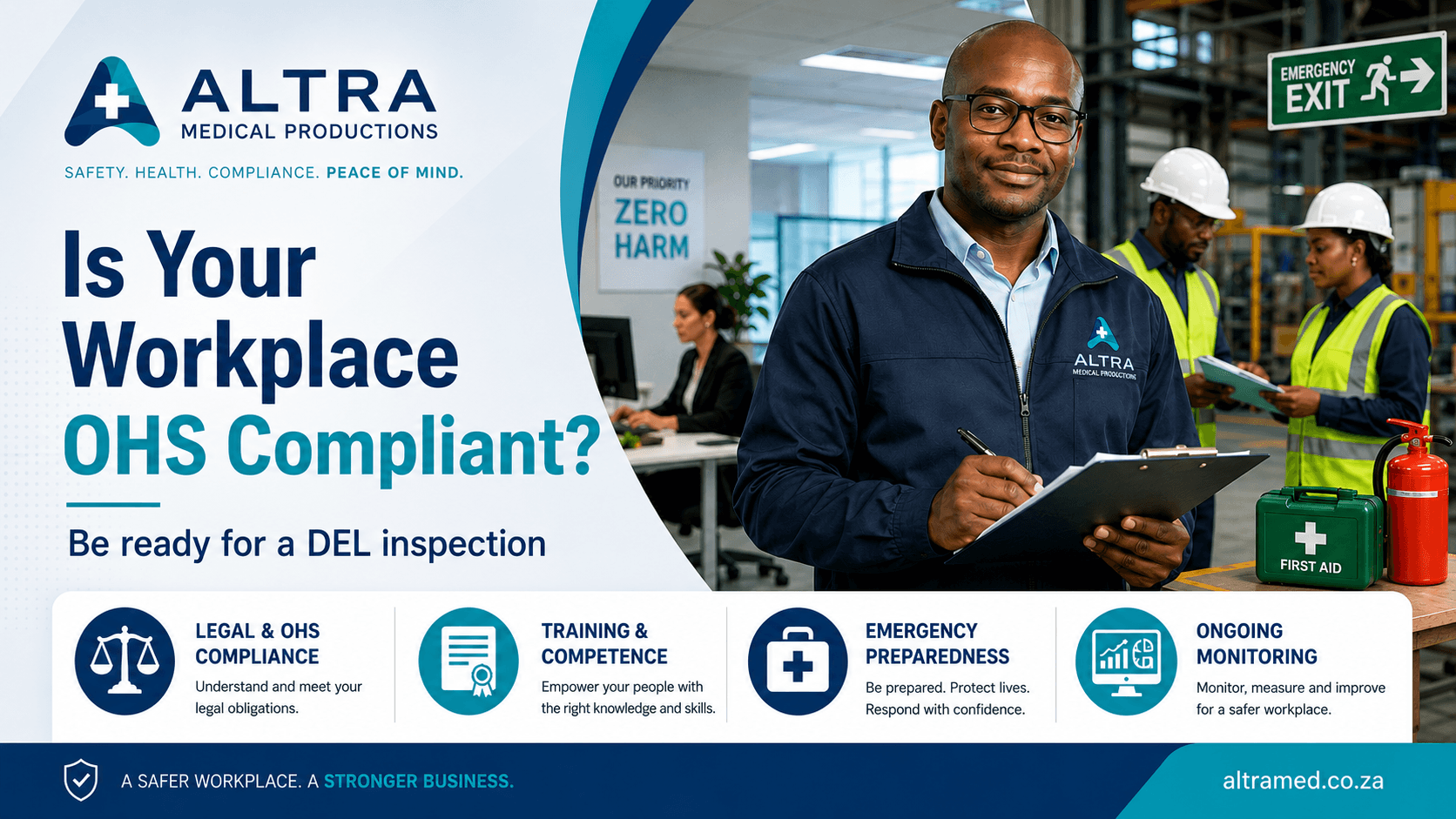

Being OHS compliant is not the same as having a safety file on a shelf. A compliant workplace should be able to show that its hazards have been identified, the necessary controls are in place, employees are properly informed and trained, required appointments are current, inspections are being completed and emergency arrangements work in practice.
The simplest test is this: if a Department of Employment and Labour inspector arrived today, could you confidently explain how your workplace manages health and safety — and produce evidence that the system is actually working?
Direct answer: To know whether your workplace is OHS compliant, look at four things together: DEL/OHS compliance, required safety training and competence, emergency preparedness, and ongoing compliance management. If one of these exists only on paper, the business may still have a significant compliance gap.
OHS compliance is a system, not a document
Section 8 of the Occupational Health and Safety Act requires every employer to provide and maintain, as far as reasonably practicable, a working environment that is safe and without risk to employees.
That duty includes identifying hazards, implementing suitable controls, providing information, instruction, training and supervision, and enforcing the measures necessary for health and safety.
This is why a company cannot answer the question “Are we compliant?” by pointing only to a file.
Can we show that our safety system works in the actual workplace?
The four pillars of workplace OHS compliance
| Compliance area | What good looks like |
|---|---|
| DEL / OHS compliance | Risks assessed, legal duties identified, appointments current, inspections completed and corrective actions closed. |
| Training and competence | The right employees are trained for the duties and risks they actually face, with valid records and suitable shift coverage. |
| Emergency preparedness | Emergency procedures reflect the workplace, responsible people know their roles, equipment is available and arrangements are tested. |
| Ongoing compliance management | Expiry dates, inspections, incidents, training, contractors and outstanding actions are actively monitored. |
1. DEL and OHS compliance: would your workplace stand up to inspection?
The Department of Employment and Labour does not inspect only paperwork. OHS inspectors conduct proactive inspections, investigate complaints and incidents, and enforce the OHS Act and its regulations.
Your documentation should therefore reflect what is actually happening on site.
For example, if your risk assessment states that a machine must be guarded, the guard must actually be in place. If your records identify trained first aiders, those people must still work for the company, hold valid certificates and be available when required.
2. Are your legal appointments correct and current?
Appointment letters are a common weak point because companies often create them once and forget about them.
Examples may include health and safety representatives, first aiders, incident investigators, competent persons required by specific regulations, construction appointments where applicable, and management assignments such as Section 16(2).
The important question is whether the person still works in the relevant area, understands the role, has the required competence and is actually performing the function.
Related article: Who May Be Appointed as a Health and Safety Representative?
3. Do you have the right number of health and safety representatives?
Where more than 20 employees are employed at a workplace, the OHS Act generally requires health and safety representatives to be designated.
The normal minimum ratios are one representative for every 100 employees or part thereof in shops and offices, and one for every 50 employees or part thereof in other workplaces.
Related article: How Many Health and Safety Representatives Does Your Company Need?
4. Is your statutory and risk-based training under control?
Training is one of the easiest compliance areas to lose control of. Employees resign, new people join, certificates expire and shifts change.
Training should therefore be managed as a compliance system rather than as a series of once-off bookings.
First aid
The General Safety Regulations contain specific requirements for first-aid equipment and trained first aiders, depending on employee numbers and workplace circumstances.
Related article: Does Every Shift Need Its Own Trained First Aider?
Health and safety representative training
The OHS Act requires employers to provide health and safety representatives with the training, facilities and assistance they may reasonably require to perform their functions.
Fire and emergency training
The General Safety Regulations were amended in 2025 to include specific fire precaution and means-of-egress requirements. Employers should determine, through their risk assessment and emergency arrangements, what employees need to be trained to respond safely to foreseeable emergencies.
This may include designated employees trained in basic firefighting and evacuation coordination, depending on the workplace risk and emergency plan.
Do not manage training by course name alone. Start with the legal duties, hazards, shifts and emergency arrangements, then determine who needs what competence and when it must be renewed.
5. Are your risk assessments still describing the real workplace?
A risk assessment is not useful if it describes a workplace that no longer exists.
Review it when there are meaningful changes such as new machinery, new chemicals, new processes, new buildings, new contractors, staffing changes, incidents or evidence that an existing control is not effective.
Related article: What Is a HIRA? Risk Assessment Under OHSA Explained
6. Would your emergency arrangements work today?
A practical emergency system should answer: Who raises the alarm? Who calls emergency services? Who assists with evacuation? Who accounts for employees? Who provides first aid? What happens if the normal exit is unavailable? Who deals with visitors or contractors?
7. Is your emergency plan current?
An emergency plan should reflect the site’s current layout, occupancy, hazards, responsible persons and emergency resources.
Review it after meaningful changes to escape routes, assembly points, processes, staffing, shifts, responsible employees or after lessons identified during an emergency drill.
8. Are your evacuation procedures understood by employees?
Employees should understand the basic actions expected of them in an emergency, including how alarms are communicated, which routes to use, where to assemble and who to report to.
9. When did you last test the emergency plan?
Emergency drills test assumptions that cannot be checked by reading a procedure. A drill may reveal that an alarm cannot be heard, a route becomes congested, employees go to the wrong assembly point, responsible people are absent, or nobody knows who is responsible for visitors.
Problems identified during drills should be recorded and corrected.
10. Is your firefighting equipment suitable and accessible?
The 2025 General Safety Regulations amendment requires employers, having regard to workplace size, construction, location and the amount and type of flammable materials, to provide an adequate supply of suitable firefighting equipment at strategic locations and keep it in good working order.
11. Does your documentation prove implementation?
Useful records include completed inspections, training certificates, committee minutes, incident investigations, corrective-action close-outs, emergency drill reports, equipment service records and contractor verification records.
Empty templates do not prove compliance.
12. Do you control expiry dates?
A workplace may be compliant in January and exposed by June simply because training, medicals, equipment certificates or other records expired without anyone noticing.
13. Are contractors creating hidden risk?
Contractor compliance should match the nature of the work and may need to address competence, risk assessments, training, equipment, appointments, induction and monitoring.
Related article: Does Every Subcontractor Need a Separate Safety File?
14. Do managers understand their own responsibilities?
OHS compliance cannot sit entirely with the safety officer. Managers and supervisors control people, equipment, budgets, production and work methods.
Related article: Does Appointing a Safety Officer Transfer Management’s Legal Liability?
15. The best test: could you demonstrate compliance?
If an inspector asks, “Show me how you know this hazard is controlled,” the strongest answer is not simply “It is in our safety file.”
A stronger answer is: “Here is the risk assessment, here is the procedure, here is the training record, here are the completed inspections, and here is the corrective action from the last problem we found.”
The goal is not a perfect file. The goal is a workplace where management knows its risks, knows its obligations, knows what is outstanding and can prove that corrective action is being managed.
Frequently asked questions
How do I know if my business is OHS compliant?
Review the actual workplace and supporting records against the OHS Act and regulations that apply to your activities. Check risk assessments, controls, appointments, training, inspections, incidents, emergency arrangements and outstanding corrective actions together.
Does every company need a safety file?
Construction work has specific health and safety file requirements under the Construction Regulations. General workplaces still need the records required by the OHS Act and applicable regulations, but there is not one universal statutory safety-file format for every business.
What safety training does my company legally need?
It depends on employee numbers, the duties people perform, workplace hazards and the regulations that apply. Some roles have specific competence requirements, while other training follows from the employer’s duty to provide necessary information, instruction, training and supervision.
Do all workplaces legally need fire-fighting and evacuation-warden certificates?
There is not one universal rule requiring every employer to train a fixed number of people under those exact course titles. Employers must provide suitable fire precautions, means of egress and emergency arrangements and determine the competence required for their workplace risks.
Can Altra Medical check whether our workplace is compliant?
Yes. A legal compliance audit can compare the workplace, documentation, appointments, training and emergency arrangements against applicable requirements and identify corrective actions in priority order.
Would you know what to show a DEL inspector tomorrow?
Altra Medical Productions helps South African employers understand what is required, identify compliance gaps and put practical systems in place covering OHS compliance, training, legal appointments and emergency preparedness.
We can assess your current workplace, identify what is missing and help you build an ongoing compliance programme instead of waiting for the next inspection or incident.
Related articles and services
- OHS Legal Compliance Audit
- How to Prepare for a Department of Employment and Labour Safety Inspection
- Health and Safety Training
- Does Every Shift Need Its Own Trained First Aider?
- Who May Be Appointed as a Health and Safety Representative?
- Does Appointing a Safety Officer Transfer Management’s Legal Liability?
Legal references
- Occupational Health and Safety Act 85 of 1993 — particularly Section 8
- General Safety Regulations, including the 2025 amendment relating to fire precautions and means of egress
This article provides general information and does not replace a workplace-specific legal compliance assessment.
altramed_how_do_i_know_if_m


0 Comments