
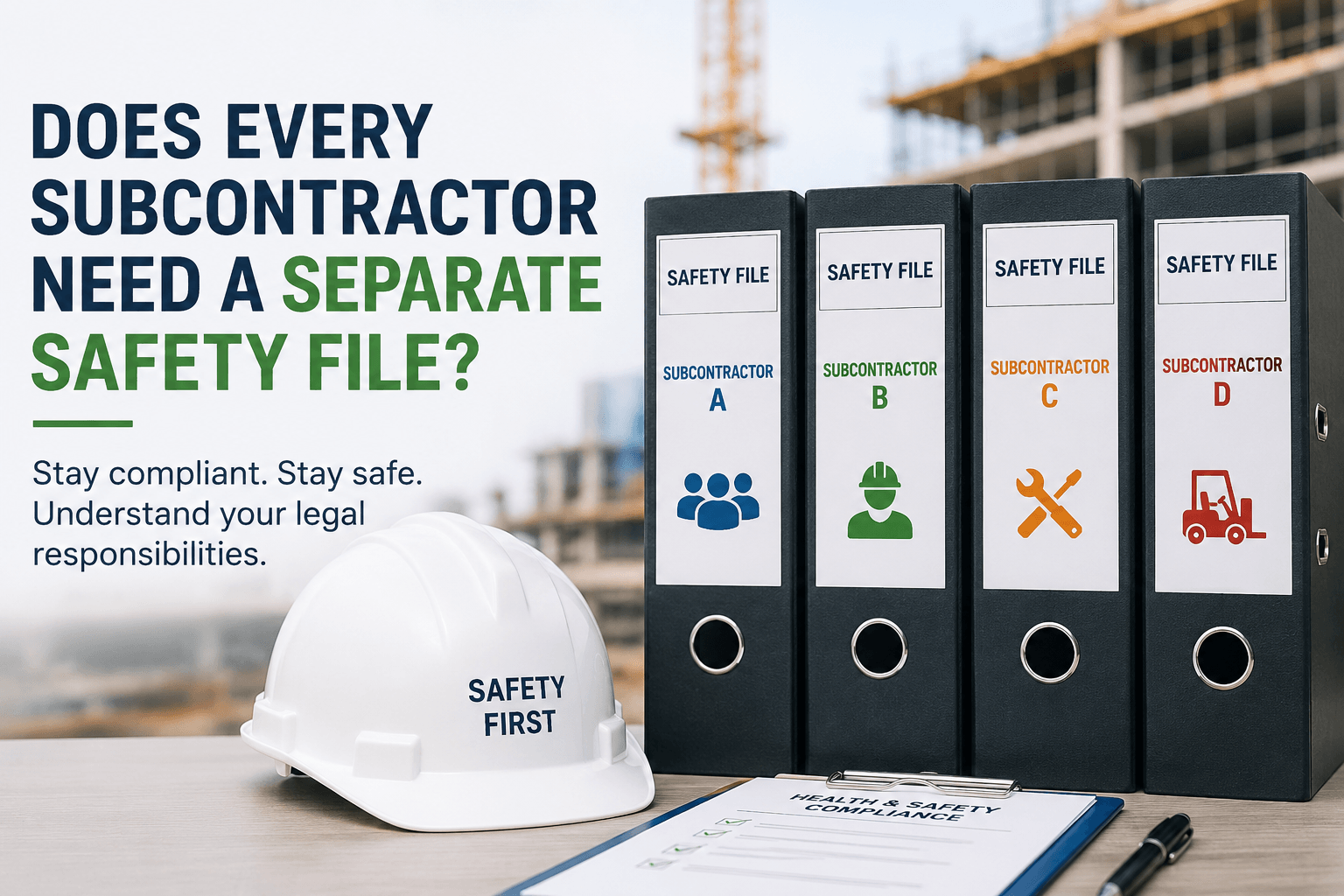

Yes. A subcontractor performing construction work must keep its own health and safety documentation for the work it performs. Under Construction Regulation 7, a contractor must prepare a suitable health and safety plan before starting work and must open and keep a health and safety file on site containing the documents required by the OHS Act and the Construction Regulations.
This does not mean that every contractor’s file must contain exactly the same documents. The contents must match that contractor’s actual scope, hazards, employees, equipment and legal duties.
If a subcontractor needs help preparing or updating its documentation, Altra Medical provides a safety file service for contractors that need project-specific plans, appointments, risk assessments and supporting compliance records.
Direct answer: If a subcontractor is performing construction work, it should not simply operate under the principal contractor’s safety file. It must maintain its own health and safety plan and file for its scope of work, while the principal contractor remains responsible for reviewing, monitoring and auditing the subcontractor’s compliance.
Why is this question so important?
On many sites, a principal contractor prepares a large project safety file and assumes that subcontractors can simply be listed inside it. That is not what the Construction Regulations require.
The Regulations create duties for both the principal contractor and every contractor working under it. The principal contractor manages the overall project system, but each contractor remains responsible for the health and safety documents and controls applicable to its own work.
1. What does Construction Regulation 7 require?
Construction Regulation 7(2) places direct duties on a contractor before performing construction work.
- Prepare and demonstrate to the principal contractor a suitable and sufficiently documented health and safety plan;
- Base the plan on the relevant sections of the client’s health and safety specification;
- Apply, review and update the plan as the work progresses;
- Open and keep on site a health and safety file;
- Include the documentation required by the OHS Act and Construction Regulations; and
- Make the file available when requested by the inspector, client, client’s agent or principal contractor.
2. Does the principal contractor’s safety file replace the subcontractor’s file?
No. The principal contractor’s file does not replace the contractor’s own file.
The principal contractor keeps the project-level health and safety file, but Construction Regulation 7 also requires each contractor to maintain its own file for the work it performs.
The principal contractor’s file should contain records showing that subcontractor compliance is being managed, such as contractor appointments, approved plans, audit reports, document-verification records, corrective actions, Compensation Fund good-standing records and a list of contractors on site.
For a broader explanation of these project duties and the contractor chain, see our Construction Regulations for Contractors guidance.
3. What should be in a subcontractor’s safety file?
- Company and project details;
- The subcontractor’s written appointment;
- Relevant parts of the client health and safety specification;
- Scope-specific health and safety plan;
- Letter of Good Standing;
- Legal appointments;
- Risk assessments;
- Method statements and safe-work procedures;
- Induction records;
- Training and competency certificates;
- Medical certificates of fitness where required;
- PPE issue records;
- Plant and equipment registers;
- Inspection and maintenance records;
- Emergency arrangements;
- Incident records;
- Toolbox talks;
- Site inspections;
- Audit findings and corrective actions; and
- Any additional records required by the contractor’s specific activities.
Related article: What Must Be Included in a Workplace Safety File? South African Checklist
4. Why should subcontractor files not all look the same?
A subcontractor’s file should reflect the work it actually performs.
An electrical contractor may need electrical isolation procedures, electrical competency records and portable electrical equipment inspections. A roofing contractor may need a fall-protection plan, working-at-height medicals, harness inspections, anchor-system information and rescue arrangements.
The rule is simple: the safety file must follow the work. Different hazards, equipment and work methods require different documentation.
5. What must the principal contractor do before appointing a subcontractor?
- Confirm that the contractor has the necessary competence;
- Confirm that sufficient resources are available to perform the work safely;
- Check that adequate provision has been made for health and safety costs;
- Verify Compensation Fund or licensed compensation-insurer good standing;
- Provide the relevant parts of the health and safety specification; and
- Appoint the contractor in writing for the relevant part of the project.
6. Does the subcontractor need its own health and safety plan?
Yes. Construction Regulation 7(2)(a) specifically requires the contractor to provide and demonstrate a suitable health and safety plan to the principal contractor before performing construction work.
The plan should explain the contractor’s scope, responsibilities, hazards, controls, competence requirements, plant and equipment, inspections, emergency arrangements and how the plan will be reviewed when work changes.
Related article: Safety File vs Health and Safety Plan: What Is the Difference?
7. Must the principal contractor approve the subcontractor’s plan?
Yes. The principal contractor must discuss and negotiate the contents of the contractor’s health and safety plan and then approve it for implementation.
The review should confirm that the plan matches the real scope, identifies the hazards, proposes suitable controls and is supported by competent people, valid medicals, training, plant records and realistic emergency arrangements.
8. How often must subcontractor safety files be audited?
The Construction Regulations require periodic site audits and document verification at intervals agreed between the principal contractor and contractor, but at least once every 30 days.
The audit should compare the file with the actual work. It should verify current employees, valid training and medicals, equipment on site, risk assessments, work methods, inspections and closure of previous findings.
If you need an independent review of whether the documentation matches the actual site, an OHS compliance audit can help identify gaps between the file and what is happening in practice.
9. Can the principal contractor stop a subcontractor from working?
Yes. The principal contractor must stop construction work that does not comply with the client’s health and safety specification or the principal contractor’s health and safety plan, or that poses a threat to health and safety.
10. What if the subcontractor appoints another subcontractor?
The responsibility continues down the contractor chain. Construction Regulation 7(3) provides that when a contractor appoints another contractor, the relevant principal-contractor duties apply to that contractor in relation to the contractor it appoints.
11. Must every small subcontractor have a large file?
No. The file must be sufficient for the work being performed, but that does not mean every contractor needs a 300-page file.
A simple, low-risk, short-duration activity may require a relatively small file. A specialist contractor performing high-risk work may require substantially more documentation.
The important question is not how thick the file is. The important question is whether it contains the documents and evidence needed to control the contractor’s actual work.
12. Example: three subcontractors on one site
Electrical contractor
- Electrical work risk assessment;
- Isolation and lockout procedure;
- Electrical competency records;
- Portable electrical equipment inspections; and
- Electrical tool registers.
Roofing contractor
- Fall-protection plan;
- Working-at-height medicals;
- Fall-arrest training certificates;
- Harness and lanyard inspection registers;
- Anchor-system documentation;
- Roof-access method statement; and
- Rescue procedure.
Painting contractor
- Chemical risk assessment;
- Safety data sheets;
- Respiratory and skin-protection controls;
- Ladder or access-equipment records;
- Ventilation controls; and
- Waste-disposal procedures.
All three contractors work on the same project, but their files should not be identical.
13. Common mistakes principal contractors make
1. Keeping one master file for everybody
The principal contractor records the subcontractors’ names but does not require scope-specific files.
2. Accepting copied safety files
Different contractors submit almost identical risk assessments and procedures with only the company name changed.
3. Checking the file only once
The file is approved at the start and never reviewed again as workers, equipment and work methods change.
4. Allowing work while documents are outstanding
The activity starts before training, medicals, appointments or equipment certificates have been verified.
5. Failing to check competence
Appointment letters exist, but there is no evidence that the appointed people are competent.
6. Ignoring expired documents
Medical certificates, training records, Letters of Good Standing and equipment records expire during the project.
7. Auditing paperwork but not the work
The file looks compliant, but employees are not following the approved work methods.
14. Subcontractor safety-file approval checklist
- Confirm the contractor’s exact scope of work.
- Issue the relevant sections of the client health and safety specification.
- Verify Compensation Fund good standing.
- Confirm competence and resources before appointment.
- Appoint the contractor in writing.
- Review and approve the contractor’s health and safety plan.
- Check that the contractor has opened its own safety file.
- Verify legal appointments.
- Confirm training and medical fitness.
- Check that risk assessments match the actual activities.
- Review method statements and procedures.
- Verify plant and equipment documentation.
- Confirm PPE records.
- Review emergency and rescue arrangements.
- Complete site induction before allowing entry.
- Audit the contractor and verify documents at least every 30 days.
- Track and close corrective actions.
- Review the file when scope, personnel or equipment changes.
- Stop unsafe or non-compliant work where necessary.
- Collect relevant records for the final consolidated project file.
Frequently asked questions
Does every subcontractor need a separate safety file?
Where a subcontractor is performing construction work, Construction Regulation 7 requires that contractor to open and keep a health and safety file on site containing the documentation required by the OHS Act and Construction Regulations.
Can the subcontractor use the principal contractor’s safety file?
No. The principal contractor’s project file does not replace the contractor’s own file for its scope of construction work.
Does every subcontractor need a health and safety plan?
Yes. Before performing construction work, the contractor must provide the principal contractor with a suitable and sufficiently documented health and safety plan based on the relevant health and safety specification.
Who approves a subcontractor’s health and safety plan?
The principal contractor discusses and negotiates the contents of the contractor’s plan and approves it for implementation.
How often must a subcontractor’s safety file be audited?
Periodic site audits and document verification must take place at mutually agreed intervals, but at least once every 30 days.
Can a small contractor have a smaller safety file?
Yes. The amount of documentation should be appropriate to the contractor’s actual scope, hazards and applicable requirements. The file must still fully address the work.
What happens if a subcontractor changes its scope?
The health and safety plan, risk assessments, procedures and supporting records should be reviewed and updated before the changed work proceeds.
Can an OHS consultant prepare the subcontractor’s safety file?
Yes. A competent consultant can assist with development and maintenance of the file, but the contractor remains responsible for implementing the controls and ensuring the documents accurately reflect the work.
Need a contractor or subcontractor safety file?
Altra Medical Productions develops project-specific safety files, health and safety plans, risk assessments and contractor documentation for construction work.
We can also review existing subcontractor files, identify missing or expired documents and help establish a practical contractor-approval and audit process.
Related articles and services
- What Must Be Included in a Workplace Safety File? South African Checklist
- Safety File vs Health and Safety Plan: What Is the Difference?
- Safety File Services
- Risk Assessment Services
- Legal Compliance Audits
- Construction Regulations for Contractors Training
Legal references
- Occupational Health and Safety Act 85 of 1993
- Construction Regulations, 2014 — particularly Regulation 7
This article provides general information and is not a substitute for a project-specific legal-compliance assessment. Requirements should be confirmed against the current legislation, client health and safety specification, contract, scope of work and project risk profile.



0 Comments