
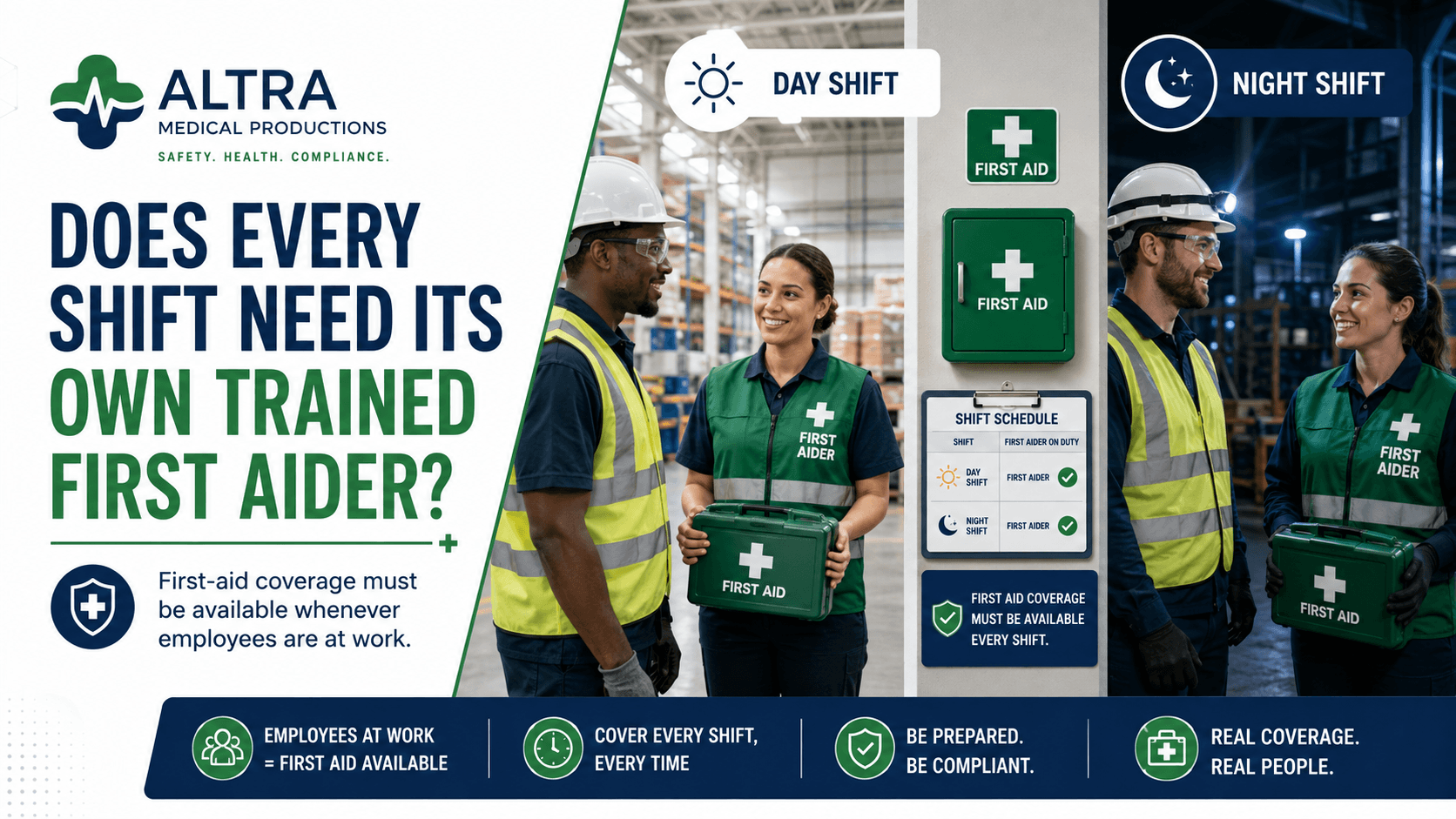

Does every shift need its own trained first aider? In a shift-based workplace, the important requirement is that the necessary first-aid competence is actually available whenever employees are working.
It is not enough to have trained first aiders somewhere on the company payroll if none of them is present on a particular shift.
Direct answer: Where the trained-first-aider requirement applies, the employer must ensure that a person with a valid first-aid certificate is readily available during normal working hours. In a workplace operating multiple shifts, this means first-aid coverage must be maintained on each shift on which employees are working, including night shifts, weekends and overtime where applicable.
Start with the basic GSR 3 requirement
General Safety Regulation 3 sets the basic workplace first-aid requirements.
First-aid box or boxes
Required when more than 5 employees are employed at the workplace.
Trained first aider
Required when more than 10 employees are employed at the workplace.
Where more than 10 employees are employed, the normal minimum ratio is:
- Other workplaces: at least one trained first aider for every group of up to 50 employees.
- Shops and offices: at least one trained first aider for every group of up to 100 employees.
The critical words for shift work are readily available during working hours.
Related article: How Many First Aiders Does Your Workplace Need?
Why shift work creates a compliance gap
A company may appear compliant when HR looks only at its total number of trained first aiders.
For example:
- 120 employees work across day and night shift;
- Three employees hold valid first-aid certificates;
- All three work day shift.
On paper, the company has several trained first aiders.
In practice, the night shift has none.
The correct question is not “How many first aiders does the company employ?” It is “How many trained first aiders are actually available on this shift, in this workplace, right now?”
Does every shift legally need a separate person?
The regulation does not use the phrase “one first aider per shift” as a separate formula.
Instead, it requires the necessary first-aid competence to be readily available during working hours.
In a business that operates more than one shift, the practical effect is that each working shift must have adequate coverage.
This may be achieved by:
- Different trained first aiders on different shifts;
- Employees whose working hours overlap shifts;
- Rotating trained staff; or
- Another arrangement that genuinely keeps the required competence available.
The arrangement must work in practice, not only on a spreadsheet.
Night shift
Night shift often creates the biggest gap.
Management, HR staff and many appointed safety personnel may work normal office hours while production, warehousing, security or maintenance continues overnight.
If night-shift employees are working, the employer should confirm:
- How many employees are present;
- Which trained first aider is present;
- Whether that person’s certificate is valid;
- Where the person is located;
- Whether the person can realistically respond quickly; and
- Who provides backup if that person is absent.
Weekend and overtime work
First-aid coverage should also be considered when employees work outside the normal roster.
This includes:
- Saturday work;
- Sunday work;
- Public holidays;
- Planned overtime;
- Emergency maintenance;
- Shutdowns; and
- After-hours call-outs.
A workplace can unintentionally lose first-aid coverage when an unusual work period is approved without checking whether a trained first aider will also be present.
Leave and sick leave
A compliant roster can become non-compliant when a key first aider goes on leave.
Common problems include:
- The only night-shift first aider taking annual leave;
- A trained person being booked off sick;
- An employee being transferred to another department;
- A trained person resigning; or
- A first aider being away on external training.
That is why employers should plan backup coverage rather than relying on only one person.
Do you need more first aiders than the legal minimum?
Sometimes, yes.
The numerical ratio is only the starting point.
Additional first aiders may be justified where:
- The workplace is large or spread out;
- Employees work in separate buildings;
- There are high-risk work areas;
- Access between departments is restricted;
- Employees work remotely;
- Professional medical assistance takes longer to arrive; or
- One person’s absence would immediately remove required coverage.
The workplace risk assessment should support these decisions.
Related article: Risk-Based First Aid Training: Matching Course Level to Your Workplace Risk Profile
Different departments can create hidden gaps
Even within the same shift, a company can have a first-aid coverage problem if the trained person is too far away.
For example, a first aider based in an administration building may not provide realistic response coverage for a warehouse several hundred metres away.
Consider:
- Distance;
- Different floors;
- Separate buildings;
- Access-controlled areas;
- Production zones; and
- How quickly the first aider can actually reach an injured person.
First-aid level and shift coverage are different issues
A company can also make the mistake of focusing on course level while ignoring availability.
One highly trained person on day shift does not provide first-aid coverage for employees working at night.
The employer must consider both:
- What competence is appropriate for the workplace risk?
- How many trained people are needed to maintain actual coverage?
Related article: First Aid Level 1 vs Level 2 vs Level 3: Which Does Your Workplace Need?
Use your training matrix to manage shifts
A training matrix should show enough information to reveal shift-related gaps.
| Field | Why it matters |
|---|---|
| Employee name | Identifies the trained person |
| Department | Shows where the person normally works |
| Shift | Reveals day/night/weekend coverage |
| First-aid training | Records the competence held |
| Expiry / renewal | Prevents certificates lapsing unnoticed |
| Backup | Shows who covers leave and absence |
Related article: How to Build an OHS Training Matrix That Keeps Your Workplace Compliant
HR and supervisors should work together
HR may know who holds valid certificates, but supervisors know who is actually working each shift.
That is why first-aid coverage should be managed jointly.
A practical arrangement is:
HR tracks certificates, training dates and expiry.
Operations / supervisors track rosters, shifts, leave and actual daily availability.
OHS management checks whether the arrangement meets the legal and risk-based requirements.
What should happen when the roster changes?
Whenever a roster changes, the first-aid coverage should be checked.
This is particularly important when:
- A new shift starts;
- Short time is introduced;
- Employees move between shifts;
- A department begins weekend work;
- A trained first aider resigns; or
- The company restructures working hours.
Do not wait for the next annual training review to discover the gap.
A simple shift-coverage test
For each shift, ask:
- How many employees are actually working?
- How many trained first aiders must be available?
- Who are they?
- Where are they located?
- Are their certificates current?
- What happens if one of them is absent?
If management cannot answer these questions quickly, the first-aid system needs review.
Frequently Asked Questions
Does every shift need its own first aider?
Where the trained-first-aider requirement applies, the necessary first-aid competence must be readily available during working hours. In a multi-shift workplace, this means appropriate coverage must exist on each shift on which employees are working.
Can the same first aider cover day and night shift?
Only if that person’s actual working hours make them genuinely available during both periods and the arrangement complies with applicable working-time requirements. An employee who has gone home cannot be treated as providing first-aid coverage for the night shift.
What if the night shift has fewer than 10 employees?
The specific trained-first-aider threshold in GSR 3 is linked to the workplace employment requirement rather than simply treating every shift as a separate employer. Employers should still assess whether adequate emergency first-aid arrangements are reasonably necessary for employees working at night, particularly where the work is hazardous or professional medical help is not immediately available.
What happens if our only first aider is on leave?
The employer should ensure suitable backup arrangements so that required first-aid coverage is not lost when the designated person is absent.
Does overtime require first-aid coverage?
If employees are working and the first-aider requirement applies, the necessary competence should be available during that work period. Overtime should therefore be included when planning first-aid coverage.
Do we need extra first aiders for a large site?
Possibly. Distance, separate buildings, restricted areas and high-risk departments may justify additional first aiders even where the basic employee ratio appears adequate.
Do all your shifts have adequate first-aid coverage?
Altra Medical Productions can help you review employee numbers, shifts, departments, certificate expiry dates and backup coverage to identify first-aid gaps.
We also provide workplace first-aid training and can help you build a practical training matrix that stays current as your workforce changes.
Related articles and services
- First Aid Training
- How Many First Aiders Does Your Workplace Need?
- Risk-Based First Aid Training
- First Aid Level 1 vs Level 2 vs Level 3
- How to Build an OHS Training Matrix
- What Safety Training Does My Company Legally Need?
Legal reference
General Safety Regulation 3, issued under the Occupational Health and Safety Act 85 of 1993.
This article provides general information. First-aid coverage should be determined with reference to current legislation, employee numbers, working hours, workplace risks and the practical availability of trained first aiders.



0 Comments