
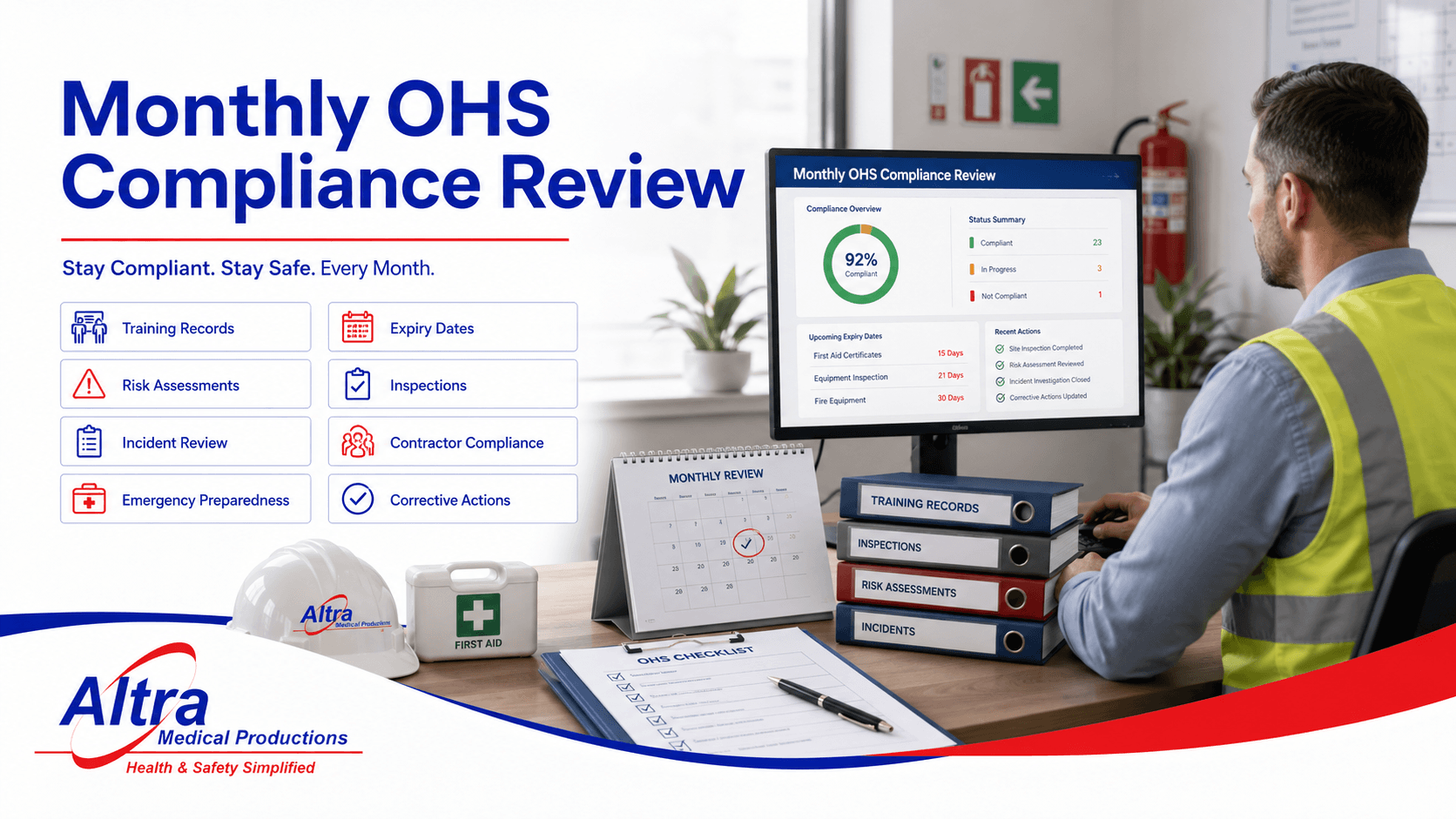

OHS compliance can deteriorate surprisingly quickly. A trained first aider resigns. A certificate expires. A new machine is installed. A contractor starts work. An emergency exit becomes blocked. A corrective action is forgotten.
That is why many employers benefit from a structured monthly OHS compliance review — not because the OHS Act creates one universal monthly audit requirement for every workplace, but because a regular review helps management identify gaps before they become incidents or Department of Employment and Labour findings.
Direct answer: A useful monthly OHS compliance review should look at changes in the workplace, open hazards, legal appointments, training and expiry dates, inspections, incidents, contractors, emergency preparedness and overdue corrective actions. The purpose is to answer one management question: what has changed since last month that could affect our compliance or risk?
Why compliance needs ongoing attention
Many businesses treat health and safety as an annual exercise.
The file is reviewed before an audit, training is booked when somebody notices an expired certificate, and risk assessments are updated only after a major change or incident.
The problem is that the workplace changes continuously.
People join and leave. Equipment changes. Contractors come onto site. New chemicals are introduced. Procedures are changed to meet production needs. Small defects appear.
A monthly review gives management a regular opportunity to catch those changes while they are still manageable.
A monthly OHS review is not about creating more paperwork. It is about preventing small compliance gaps from becoming large ones.
1. Start with one question: what changed this month?
This is the most useful starting point.
Before opening the safety file, ask managers and supervisors whether anything changed in the workplace during the past month.
For example:
- Did new employees start?
- Did anyone resign or transfer?
- Was new equipment installed?
- Did a work process change?
- Did a new contractor start work?
- Were new chemicals introduced?
- Was a department relocated?
- Did shifts or working hours change?
- Was there an incident or near miss?
Each change may affect appointments, training, risk assessments, procedures, emergency arrangements or inspection requirements.
2. Review open hazards and corrective actions
The monthly review should not become another inspection that generates a fresh list of findings while last month’s findings remain unresolved.
Start with what is already open.
For each significant finding, management should know:
What is the risk? Who is responsible? What temporary control is in place? When must it be corrected? Is the action actually closed?
Repeated overdue findings are a warning that the OHS system is identifying problems without managing them.
Related article: 7 Signs Your Workplace Is Not Ready for a DEL Inspection
3. Check whether legal appointments still reflect reality
An appointment can become outdated even when the signed letter has not expired.
An employee may have resigned, moved departments, changed shifts or been promoted into a different role.
The monthly review should therefore ask whether the people listed in the OHS system still:
- Work for the company;
- Work in the area they represent or control;
- Understand their duties;
- Have the required competence; and
- Are actually carrying out the role.
This is particularly important for first aiders, health and safety representatives, incident investigators, risk assessors and other competent-person appointments.
4. Review training and certificate expiry dates
Training compliance should be monitored before certificates expire, not after.
The monthly review should highlight training that will expire soon enough for management to arrange replacements without creating a coverage gap.
The review should also consider whether staffing changes have created a new need.
For example, the total number of first aiders may still appear correct, but a shift change could leave the night shift with no trained person available.
Related article: What Safety Training Does My Company Legally Need in South Africa?
5. Compare the training matrix with the actual workforce
A training matrix is only useful if it matches the employees who are actually working.
HR records and OHS records should therefore be compared regularly.
Look for:
new starters with missing training, employees who have left but remain on the matrix, changed shifts, transferred employees and people performing duties for which no competence record can be found.
This is one of the easiest ways to uncover hidden compliance gaps.
6. Check current risk assessments against actual work
A risk assessment does not necessarily need to be rewritten every month.
But the monthly review should ask whether anything has changed that makes the current assessment inaccurate.
If new machinery, substances, work methods or contractors were introduced, a review may be necessary.
The key question is:
“Does our current risk assessment still describe what people are actually doing?”
7. Look at workplace inspections — not just whether forms were completed
Inspection records should tell management something useful.
If every inspection form has been marked “compliant” for six months, but obvious hazards are visible in the workplace, the inspection process is not working.
Review the quality of findings.
Are supervisors identifying defects? Are health and safety representatives raising concerns? Are equipment inspections uncovering deterioration before failure?
A good inspection system should create some findings from time to time because workplaces are dynamic.
8. Review incidents and near misses
Even a relatively minor incident can reveal a weakness in the OHS system.
The monthly review should look for patterns rather than treating each incident as an isolated event.
For example:
Three minor hand injuries may point to inadequate guarding, poor work methods or incorrect gloves.
Several slips in the same area may indicate a housekeeping or drainage problem.
The purpose is to ask:
What is the workplace trying to tell us before a more serious incident occurs?
9. Check emergency preparedness
Emergency arrangements can become outdated without anyone noticing.
A warden leaves the company. A first aider changes shift. An exit is temporarily blocked during a project. A department moves to another floor.
During the monthly review, ask whether any change has affected:
- Emergency contacts;
- First-aid coverage;
- Emergency roles;
- Escape routes;
- Assembly points;
- Emergency equipment; or
- People who may require assistance.
You do not necessarily need to rewrite the emergency plan every month. You do need to know when it has become inaccurate.
10. Review contractor activity
Contractors often create fast-moving compliance risks because they may start and finish work within a short period.
The monthly review should confirm which contractors are currently on site, what work they are performing and whether their documentation and controls remain suitable.
If the work is construction work, the more specific duties of the Construction Regulations must also be considered.
Related article: Does Every Subcontractor Need a Separate Safety File?
11. Check whether OHS meetings and consultations are taking place
Where health and safety committees are required, Section 19 of the OHS Act requires them to meet as often as necessary but at least once every three months.
A monthly management review is not the same thing as a statutory health and safety committee meeting.
However, the monthly review can check whether the committee is functioning, whether recommendations are being tracked and whether employee concerns are reaching management.
12. Review expiry-sensitive records
Some compliance records have clear expiry or renewal dates. Others need review because conditions have changed.
A monthly dashboard can flag items approaching expiry, such as:
- Training certificates;
- Medical certificates where applicable;
- Equipment inspection or test records;
- Professional registrations where applicable;
- Letters of Good Standing;
- Contractor documents; and
- Other time-sensitive records relevant to the workplace.
The objective is to act before the expiry creates a compliance gap.
13. Check whether management decisions are holding up corrective action
Some findings cannot be closed by the safety officer.
A damaged machine may need capital expenditure. A guarding problem may require production downtime. Additional trained employees may need budget approval.
The monthly review should therefore identify issues that are stuck because they require management authority.
This is where the review becomes a business-management tool rather than an OHS filing exercise.
Related article: Does Appointing a Safety Officer Transfer Management’s Legal Liability?
14. What should management see each month?
The monthly report does not need to be 50 pages long.
A concise dashboard can provide far more value.
| Area | What management should know |
|---|---|
| High-risk findings | What remains open and what immediate controls exist |
| Training | Expiring, expired and missing competence |
| Appointments | Vacancies, changes and outdated appointments |
| Incidents | New incidents, trends and corrective actions |
| Inspections | Important findings and recurring defects |
| Emergency preparedness | Changes affecting roles, equipment or procedures |
| Contractors | Current contractors and significant compliance issues |
| Management actions | Items requiring budget, authority or escalation |
15. Does the law require a monthly OHS compliance audit?
There is no single general provision in the OHS Act requiring every employer, regardless of industry and risk, to conduct one identical monthly OHS compliance audit.
Different regulations and duties have their own inspection, meeting, testing or review frequencies.
For example, health and safety committees must meet as often as necessary but at least once every three months. Other equipment or specialist regulations may prescribe very different intervals.
A monthly compliance review is therefore best understood as a practical management cadence that helps the employer keep track of all those different obligations.
Monthly does not mean every legal requirement is monthly. It means management checks each month whether the different legal and risk-based requirements are being completed at the correct frequency.
16. Why monthly reviews help with DEL inspection readiness
A company that reviews compliance every month should not need to reconstruct its OHS system when an inspector arrives.
The current position is already known.
Management knows what is compliant, what is approaching expiry, what is outstanding and what is being corrected.
That is a much stronger position than trying to create the appearance of compliance after receiving notice of an inspection.
Related article: How to Prepare for a Department of Employment and Labour Safety Inspection
17. Who should own the monthly review?
The review can be coordinated by an internal safety officer, OHS coordinator, HR manager, operations manager or external OHS consultant.
But it should not happen in isolation from management.
The person coordinating the review needs access to information from:
HR, operations, maintenance, supervisors, health and safety representatives, contractors and management.
Most importantly, somebody with management authority must receive the findings and make sure actions are completed.
Frequently asked questions
Is a monthly OHS audit compulsory in South Africa?
There is no single general rule requiring every employer to conduct the same monthly OHS audit. Specific regulations have their own required frequencies. A monthly review is a practical way to monitor those obligations and identify changes before gaps develop.
What should be checked in a monthly OHS review?
Review workplace changes, open hazards, corrective actions, legal appointments, training and expiry dates, risk assessments, inspections, incidents, contractors and emergency arrangements.
Should risk assessments be redone every month?
Not automatically. The monthly review should identify whether anything has changed that makes the existing assessment inaccurate or requires a formal review.
Does the health and safety committee have to meet monthly?
No. The OHS Act requires a health and safety committee to meet as often as necessary but at least once every three months. A company may choose to meet more frequently.
Who should perform the monthly OHS review?
It may be coordinated internally or by an external consultant, but management should receive the findings and ensure that corrective actions requiring authority or resources are completed.
Can Altra Medical manage the monthly review for us?
Yes. Altra Medical Productions can assist with ongoing OHS compliance management, including workplace reviews, risk assessments, legal appointments, training matrices, contractor control, corrective-action tracking and management reporting.
Are you managing OHS compliance every month — or only when there is an inspection?
Altra Medical Productions can help you move from reactive compliance to an ongoing OHS management programme that tracks training, appointments, inspections, risks and corrective actions throughout the year.
The result is a clearer compliance picture for management and far less scrambling when a client, auditor or Department of Employment and Labour inspector asks questions.
Related articles and services
- Health and Safety Officer on Retainer
- How Do I Know If My Workplace Is OHS Compliant in South Africa?
- 7 Signs Your Workplace Is Not Ready for a DEL Inspection
- How to Prepare for a Department of Employment and Labour Safety Inspection
- What Safety Training Does My Company Legally Need in South Africa?
- Does Appointing a Safety Officer Transfer Management’s Legal Liability?
Legal references
- Occupational Health and Safety Act 85 of 1993
- Section 19 — Health and safety committee meeting requirements
- Regulations applicable to the specific workplace, equipment, hazards and activities
This article provides general information. A monthly review is a practical compliance-management process and does not replace any specific inspection, test, meeting or review frequency prescribed by the OHS Act, its regulations or an applicable standard.


0 Comments