
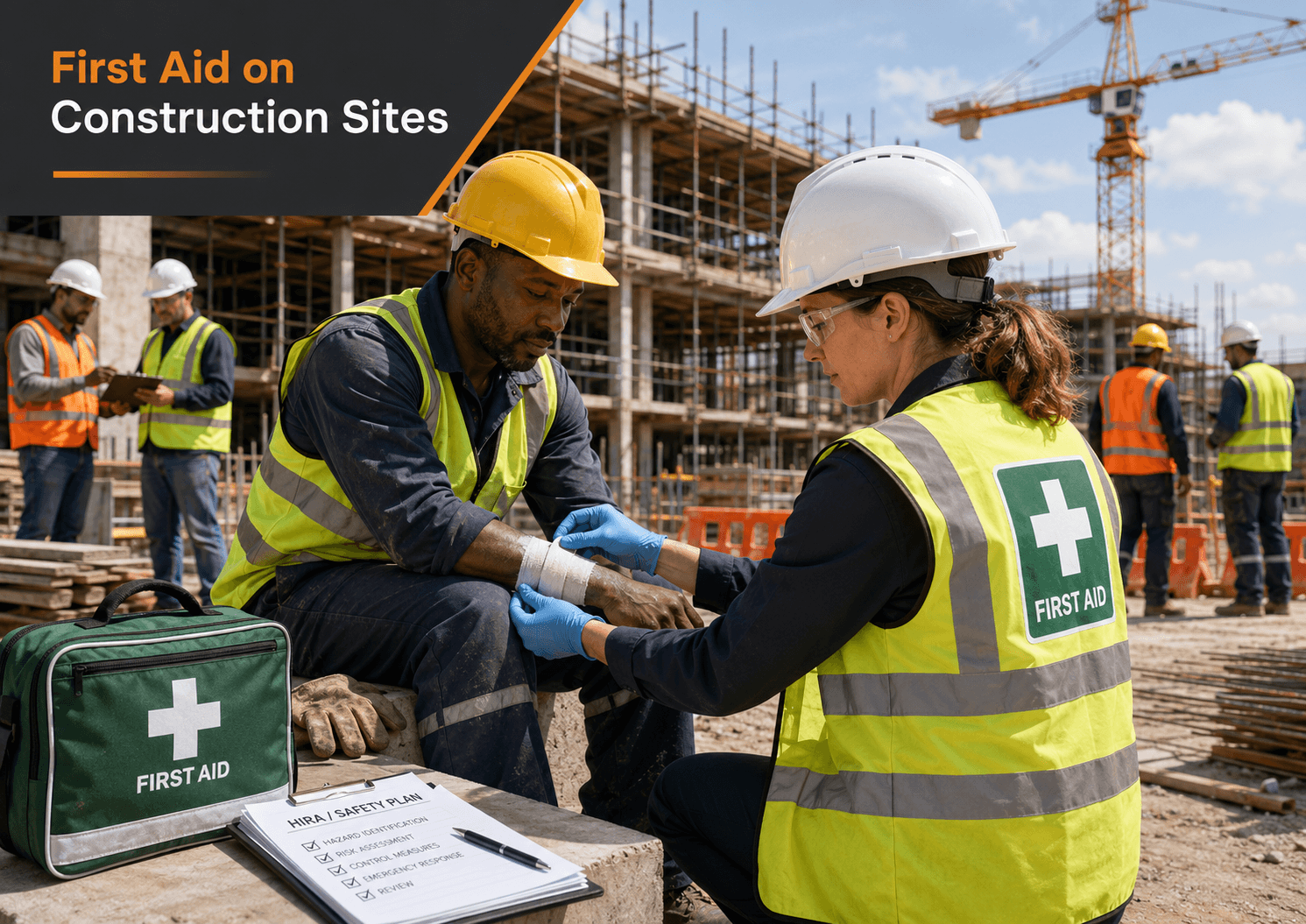

What first aid arrangements must a contractor provide on a South African construction site? Construction work is inherently higher risk, and first-aid planning should form part of the contractor’s overall health and safety system from the start of the project.
The basic first-aid requirements still come from General Safety Regulation 3, while the Construction Regulations require contractors to manage site health and safety through a documented plan, site-specific risk controls and competent resources.
Direct answer: Where more than five employees are employed at a workplace, suitable first-aid equipment must be provided. Where more than 10 employees are employed, trained first aiders must be readily available during normal working hours. On a construction site, contractors should also make sure that first-aid coverage matches the actual hazards, site layout, shifts, subcontractors and emergency response time.
The legal framework
Construction health and safety in South Africa is governed by the Occupational Health and Safety Act and the applicable Construction Regulations.
The current Construction Regulations remain the 2014 regulations. Draft Construction Regulations were published for public comment in 2025, but they were intended to replace the 2014 regulations and had not yet replaced them when this article was reviewed.
The Construction Regulations require contractors to maintain a documented health and safety plan, keep a health and safety file on site and manage the hazards associated with the work being performed.
First-aid arrangements should therefore not be treated as a stand-alone box-ticking exercise. They should form part of the site’s overall emergency preparedness and risk-control system.
First-aid box versus trained first aider
First-aid box or boxes
Required when more than 5 employees are employed at the workplace.
Trained first aider
Required when more than 10 employees are employed at the workplace.
Where more than 10 employees are employed, the normal minimum ratio is at least one trained first aider for every group of up to 50 employees in a general workplace.
Construction sites normally fall into the general workplace category rather than the shop/office category.
Related article: How Many First Aiders Does Your Workplace Need?
Construction risk often justifies more than the basic minimum
Construction work can involve a combination of serious hazards, including:
- Work at height;
- Scaffolding;
- Excavations;
- Electrical work;
- Moving plant and vehicles;
- Cutting and grinding;
- Hot work;
- Material handling;
- Sharp objects;
- Crushing and impact hazards; and
- Changing site conditions.
Because of this, contractors should not rely only on the employee ratio when planning first aid.
The site risk assessment should help determine whether additional first aiders, additional equipment or broader first-aid competence is necessary.
Do construction sites legally require First Aid Level 2 or Level 3?
There is no universal rule in General Safety Regulation 3 stating that every construction site must use First Aid Level 2 or Level 3.
A construction site may reasonably justify broader first-aid competence because of its risk profile, but the decision should be based on the actual hazards, foreseeable injuries, site location and emergency response arrangements.
For example, a small low-rise refurbishment project and a remote industrial construction project may have very different first-aid needs.
Related article: First Aid Level 1 vs Level 2 vs Level 3: Which Does Your Workplace Need?
Use the construction risk assessment to plan first aid
The first-aid plan should be informed by the hazards identified in the site’s risk assessments.
Consider:
- The types of injuries that could occur;
- The severity of those injuries;
- The number of employees and subcontractors;
- Work areas spread across the site;
- Vertical access and work at height;
- Distance from ambulance access points;
- Traffic and plant movements;
- How quickly emergency medical services can reach the site; and
- Whether work continues after normal daytime hours.
This turns first aid into a practical control measure rather than just a certificate requirement.
Shift and overtime coverage
A construction project may operate outside normal daytime hours, particularly during shutdowns, concrete pours, commissioning work or programme recovery.
If employees are working, the required first-aid competence must be available.
This means the contractor should consider:
- Day shift;
- Night shift;
- Weekend work;
- Overtime;
- Public-holiday work; and
- Temporary changes to the workforce.
A site can have enough trained first aiders on paper and still have poor first-aid coverage if those people are not present during the shift when the work takes place.
Related article: Does Every Shift Need Its Own Trained First Aider?
Subcontractors and first-aid arrangements
Construction projects often involve several contractors and subcontractors working at the same time.
The principal contractor and contractors should understand how first-aid arrangements will work across the project.
Questions to address include:
- Who provides the first-aid equipment?
- Where are the first-aid boxes located?
- Who are the trained first aiders?
- Which work areas and shifts do they cover?
- How are subcontractors informed of the arrangements?
- Who calls emergency medical services?
- Where will the ambulance enter the site?
Even where contractors coordinate shared arrangements, each employer should still make sure that its own legal duties are properly addressed.
Where should first-aid equipment be located?
First-aid equipment should be readily accessible.
On a larger project, a single first-aid box in the site office may not be adequate if employees are working far away, on multiple floors or in separate zones.
Consider:
- Site size;
- Work fronts;
- Building levels;
- Access restrictions;
- Hazardous areas;
- Remote sections; and
- Travel time to the main site office.
Additional first-aid boxes may be justified by the practical layout and risk profile even where one box technically satisfies the basic headcount threshold.
Keep first-aid boxes controlled and stocked
The contractor should ensure that first-aid boxes are suitable, accessible and maintained.
A practical control system should include:
- Assigned responsibility for inspections;
- A stock checklist;
- Replacement of used items;
- Removal of expired or damaged items;
- Protection from dust, water and contamination; and
- Clear identification and signage.
The contents should reflect the applicable legal requirements and any additional items justified by the site risk assessment.
First aid and emergency planning must work together
The Construction Regulations also require contractors to manage emergency and fire risks as part of the site health and safety system.
A proper first-aid plan should therefore connect with:
- Emergency contact numbers;
- Site alarm arrangements;
- Evacuation procedures;
- Rescue procedures;
- Fire response;
- Ambulance access;
- Emergency assembly points; and
- Incident reporting procedures.
For work at height, first aid should also be coordinated with the fall-rescue plan.
First aid is not a substitute for rescue
This is especially important on construction sites.
If an employee falls and is suspended in a harness, a trained first aider on the ground cannot resolve the emergency unless the site also has a workable rescue plan and competent rescuers.
Similarly, employees working in excavations, confined areas or difficult-access locations may require specific rescue arrangements in addition to first-aid competence.
First aid starts after safe access to the casualty has been achieved.
Training records should be kept in the health and safety system
The contractor should be able to demonstrate that the required first-aid competence exists on the project.
Records should normally include:
- First aider names;
- Certificate copies;
- Training provider details;
- Certificate dates;
- Expiry or renewal dates;
- Shift or work-area allocation; and
- Backup first-aider arrangements.
These records can form part of the site’s health and safety file and training matrix.
Related article: How to Build an OHS Training Matrix That Keeps Your Workplace Compliant
What happens if the first aider leaves the project?
Construction workforces change frequently.
Employees may transfer to another project, subcontractors may complete their scope or trained people may take leave.
If a person who provides required first-aid coverage leaves the site, the contractor should immediately review the remaining coverage.
The training matrix should make these gaps visible before they become a compliance or emergency-response problem.
Inductions should include first-aid information
The Construction Regulations require people entering a construction site to receive health and safety induction training relevant to the site’s hazards.
The induction should therefore explain practical emergency information such as:
- How to raise an alarm;
- Where first-aid boxes are located;
- How to identify or contact a first aider;
- Where the emergency assembly point is;
- How to contact site supervision; and
- Any site-specific emergency procedures.
People cannot use an emergency system effectively if they do not know it exists.
A practical construction-site first-aid check
Site management should be able to answer:
- How many people are working on site today?
- How many trained first aiders are required?
- Who are they?
- Which work areas and shifts do they cover?
- Are their certificates current?
- Where are the first-aid boxes?
- Are the boxes stocked and accessible?
- How will emergency medical services enter the site?
- Who provides backup if a first aider is absent?
- Does the current site risk profile justify additional competence or equipment?
If the site team cannot answer these questions immediately, the first-aid arrangements need review.
Frequently Asked Questions
How many first aiders are required on a construction site?
Where more than 10 employees are employed, the normal general-workplace ratio is at least one trained first aider for every group of up to 50 employees. Contractors should also consider shifts, site layout and risk, which may justify additional coverage.
Does a construction site need a first-aid box?
Where more than five employees are employed at a workplace, first-aid equipment must be provided. Construction sites may need multiple boxes depending on the size, layout and accessibility of work areas.
Must construction first aiders have Level 2 or Level 3?
There is no universal rule in General Safety Regulation 3 assigning Level 2 or Level 3 to every construction site. The appropriate competence should be based on the actual hazards, likely injuries, response time and any other applicable requirements.
Can subcontractors rely on the principal contractor’s first aiders?
First-aid arrangements may be coordinated across the project, but each employer should ensure that its own legal responsibilities are properly addressed and that suitable coverage is genuinely available to its employees.
Must first-aid records be kept in the construction health and safety file?
The construction health and safety file must contain the documentation required under the Act and Construction Regulations. Keeping current first-aider certificates and related training records in the project health and safety system is a practical way to demonstrate that the required competence is available.
Does first aid form part of the site’s emergency plan?
Yes. First aid should be integrated with emergency communications, evacuation, rescue, fire response, ambulance access and incident-reporting arrangements.
Are your construction-site first-aid arrangements adequate?
Altra Medical Productions can help contractors review employee numbers, site risks, shifts and current first-aider certificates to identify gaps before work starts or before an inspection.
We provide workplace first-aid training and can help build the training matrix and first-aid coverage plan for your project.
Related articles and services
- First Aid Training
- How Many First Aiders Does Your Workplace Need?
- Risk-Based First Aid Training
- First Aid Level 1 vs Level 2 vs Level 3
- Does Every Shift Need Its Own Trained First Aider?
- How to Build an OHS Training Matrix
- Safety Files
Legal references
- Occupational Health and Safety Act 85 of 1993
- General Safety Regulation 3
- Construction Regulations, 2014
This article provides general information. Construction-site first-aid arrangements should be based on current legislation, employee numbers, the project’s risk assessments and any site- or sector-specific requirements that apply.
altramed_first_aid_requirements
0 Comments