
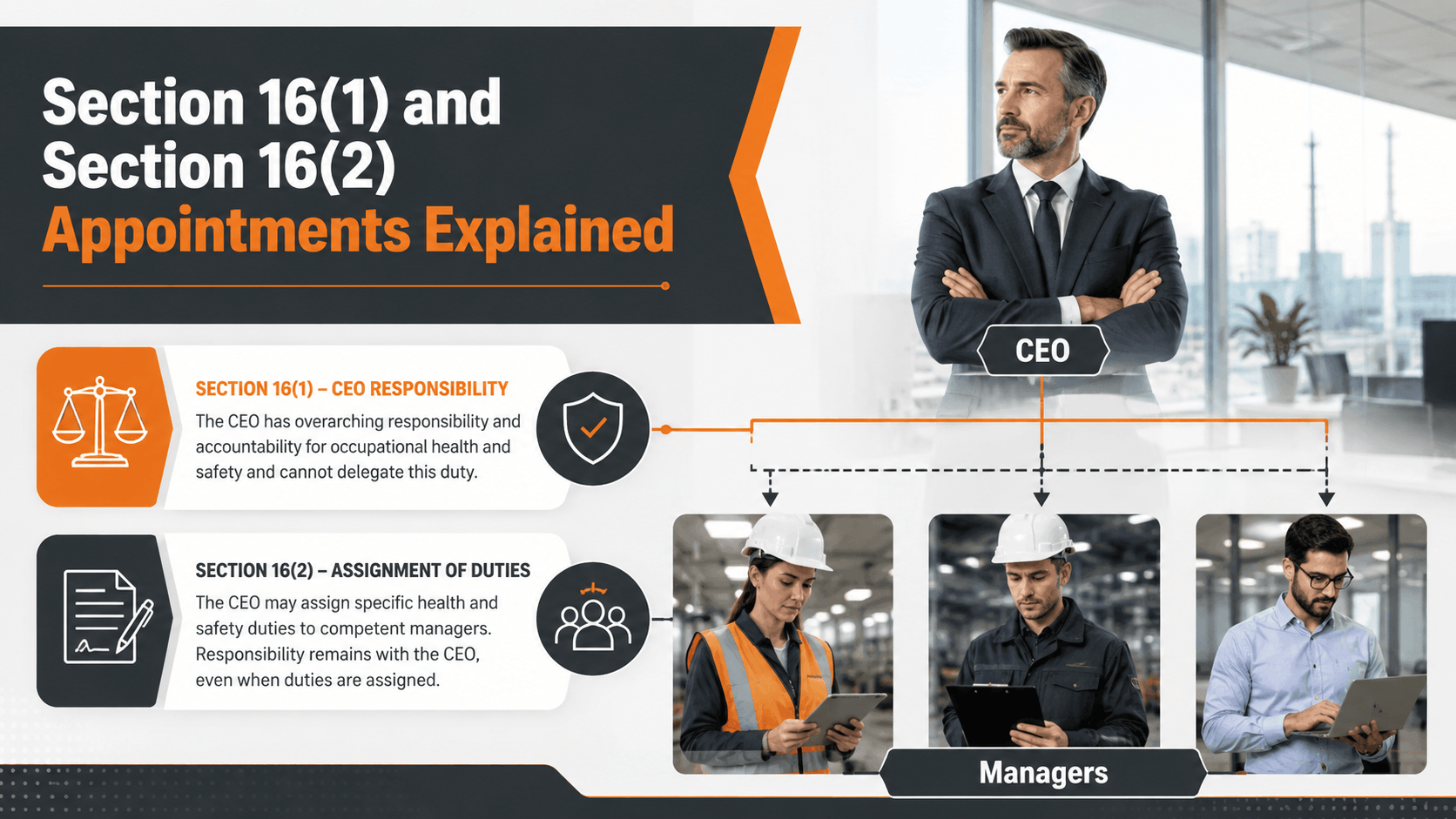

Section 16 of the Occupational Health and Safety Act places overall responsibility for ensuring that the employer’s OHS duties are properly discharged on the chief executive officer. It also allows the CEO to assign duties to managers under his or her control, but that assignment does not remove the CEO’s underlying responsibility or liability.
Direct answer: Section 16(1) places a statutory responsibility on the CEO to ensure that the employer’s duties under the OHS Act are properly discharged. Section 16(2) allows the CEO to assign specific OHS duties to a person under the CEO’s control. The CEO remains responsible despite making a Section 16(2) assignment.
Why Section 16 is often misunderstood
Many safety files contain documents called “Section 16(1) Appointment” and “Section 16(2) Appointment”. This can create the impression that both duties exist only because somebody signed a form. That is not correct.
Section 16(1) is a statutory responsibility. Section 16(2) is an assignment of duties.
1. What does Section 16(1) require?
Section 16(1) requires every chief executive officer, as far as reasonably practicable, to ensure that the duties of the employer under the OHS Act are properly discharged.
In practice, this means ensuring that the organisation has systems for:
- Risk assessments;
- Legal appointments;
- Training and supervision;
- Safe systems of work;
- Plant and equipment safety;
- Incident investigation;
- Contractor control;
- Corrective action; and
- OHS performance monitoring.
2. Who is the CEO for purposes of Section 16?
The OHS Act defines the chief executive officer as the person responsible for the overall management and control of the business. The legal position therefore depends on actual authority and control, not merely on the job title printed on a business card.
3. Does the CEO need a Section 16(1) appointment letter?
No appointment letter is required to create the CEO’s Section 16(1) responsibility. The responsibility arises directly from the Act.
A written acknowledgement may still be useful for the OHS file, but it does not create the statutory duty.
4. What does Section 16(2) allow?
Section 16(2) allows the CEO to assign duties contemplated in Section 16(1) to a person under the CEO’s control.
Typical assignees may include:
- Regional managers;
- Plant managers;
- Branch managers;
- Operations managers;
- Divisional managers; and
- Other managers with real operational control.
5. Why use Section 16(2) assignments?
A CEO cannot personally supervise every branch, department or site. Section 16(2) allows OHS duties to be distributed through the management structure to people who control the relevant work.
6. Does Section 16(2) transfer the CEO’s liability?
No. Section 16(2) expressly allows duties to be assigned without derogating from the CEO’s responsibility or liability under Section 16(1).
The CEO therefore cannot simply appoint a manager and then regard health and safety as somebody else’s problem.
7. Does Section 16 remove the employer’s liability?
No. Section 16(3), subject to Section 37, provides that the CEO’s Section 16(1) responsibility does not relieve the employer of responsibility or liability under the Act.
8. Who should receive a Section 16(2) assignment?
The person should be under the CEO’s control and should have sufficient authority, knowledge, experience, resources and operational control to perform the duties assigned.
Responsibility without authority is a poor management arrangement.
9. Can the safety officer be the Section 16(2) appointee?
Possibly, if the safety officer genuinely has the necessary management authority and control. However, the safety officer is often an adviser rather than the person who controls production, employees and budgets.
Where management needs specialist support without appointing a full-time internal resource, an outsourced health and safety officer can assist with inspections, risk assessments, training matrices, legal appointments and corrective-action tracking while operational responsibility remains with management.
For this reason, operational managers are often more suitable Section 16(2) assignees.
Related article: Safety Representative vs Safety Officer: What Is the Difference?
10. Can there be more than one Section 16(2) appointee?
Yes. Different managers may be assigned duties for different workplaces, regions, divisions or functions.
11. What should a good Section 16(2) assignment contain?
- The appointee’s name and position;
- The Section 16(2) legal reference;
- The workplace or area covered;
- The duties assigned;
- The authority granted;
- The reporting line;
- The effective date;
- The CEO’s signature; and
- The appointee’s acceptance.
A vague letter stating only that a manager is “responsible for health and safety” provides little practical value.
12. What duties may be assigned?
- Ensuring risk assessments are completed and reviewed;
- Maintaining required legal appointments;
- Ensuring employees are trained and supervised;
- Implementing work procedures;
- Monitoring PPE requirements;
- Maintaining plant and equipment inspections;
- Managing incidents;
- Monitoring contractor compliance;
- Maintaining emergency arrangements;
- Closing audit findings; and
- Reporting OHS performance to senior management.
13. What authority should the assignee have?
- Stop unsafe work;
- Issue instructions;
- Require corrective action;
- Request or allocate resources;
- Escalate serious hazards;
- Require inspections and audits; and
- Enforce company procedures.
14. What should the CEO do after making the assignments?
The CEO’s role does not end when the letters are signed. Ongoing oversight may include:
An OHS compliance audit can give the CEO and management team an objective view of whether the assigned duties, workplace controls and supporting records are actually functioning as intended.
- OHS reports;
- Management reviews;
- Legal compliance audits;
- Incident statistics;
- Corrective-action tracking;
- Risk registers;
- Training matrices; and
- Periodic review of appointments and resources.
15. Can a manager refuse to sign?
A manager should not sign a Section 16(2) assignment they do not understand or cannot practically perform. The scope, authority, resources and escalation process should be clear before acceptance.
16. Is the Section 16(2) appointee automatically personally liable if something goes wrong?
No. Potential liability depends on the facts, including what duty was assigned, what authority the person had, what they knew, what action they took and whether unresolved risks were escalated.
17. Section 16(1) vs Section 16(2)
| Question | Section 16(1) | Section 16(2) |
|---|---|---|
| Who? | Chief executive officer | Person under the CEO’s control |
| How does it arise? | Directly from the OHS Act | Assignment by the CEO |
| Purpose | Ensure employer duties are properly discharged | Distribute duties through management |
| Does it remove CEO responsibility? | Not applicable | No |
| Typical person | Person with overall management and control | Regional, plant, branch or operations manager |
18. Common Section 16 mistakes
1. Treating Section 16(1) as an ordinary appointment
The company assumes the CEO has no responsibility until a letter is signed.
2. Believing Section 16(2) transfers all liability
The CEO appoints a manager and assumes responsibility has ended.
3. Appointing somebody without authority
The manager has responsibility on paper but cannot control work or obtain resources.
4. Using generic appointment letters
The document does not define the actual area, authority or duties.
5. Appointing the safety officer by default
The organisation ignores the operational managers who actually control the work.
6. No monitoring after appointment
The letters are signed but OHS performance is never reviewed.
19. Section 16 appointment checklist
- Identify who actually functions as the CEO.
- Record the Section 16(1) responsibility clearly.
- Map the management structure.
- Identify where Section 16(2) assignments are needed.
- Assign duties only to people under the CEO’s control.
- Define each person’s area of responsibility.
- Specify the actual duties assigned.
- Confirm sufficient authority and resources.
- Provide appropriate training.
- Require regular OHS reporting.
- Monitor risks and corrective actions.
- Review assignments when the organisation changes.
- Remove obsolete appointments.
- Keep signed current copies in the OHS file.
Frequently asked questions
What is a Section 16(1) appointment?
Strictly speaking, Section 16(1) creates a statutory responsibility for the CEO rather than an ordinary appointment. The CEO must ensure, as far as reasonably practicable, that the employer’s duties under the OHS Act are properly discharged.
What is a Section 16(2) appointment?
It is an assignment by the CEO of duties contemplated in Section 16(1) to a person under the CEO’s control.
Does Section 16(2) remove the CEO’s responsibility?
No. The Act expressly preserves the CEO’s responsibility and liability under Section 16(1).
Can there be more than one Section 16(2) appointee?
Yes. Different managers may be assigned duties for different workplaces, divisions, regions or functions.
Can the safety officer be appointed under Section 16(2)?
Possibly, but only if the person has real authority and control over the duties assigned. The title “safety officer” alone does not make the person the appropriate assignee.
Does Section 16 relieve the employer of liability?
No. Section 16(3), subject to Section 37, states that Section 16(1) does not relieve the employer of responsibility or liability under the Act.
Are your Section 16 appointments more than just paperwork?
Altra Medical Productions provides OHS Legal Liability training for CEOs, managers and supervisors and can assist with reviewing legal appointments, reporting structures and workplace OHS responsibilities.
We can help ensure duties, authority and reporting lines are clearly defined and supported by a practical occupational health and safety management system.
Related articles and services
- Health and Safety Courses
- What Does OHS Legal Liability Mean for Managers and Supervisors?
- Safety Representative vs Safety Officer: What Is the Difference?
- The Role of a Safety Officer Explained
- What Must Be Included in a Workplace Safety File?
Legal references
- Occupational Health and Safety Act 85 of 1993 — Section 16
- Occupational Health and Safety Act 85 of 1993 — Section 37
This article provides general information and does not constitute legal advice. The correct Section 16 structure depends on the actual management and control of the organisation, its workplaces, reporting lines and duties assigned.



0 Comments