
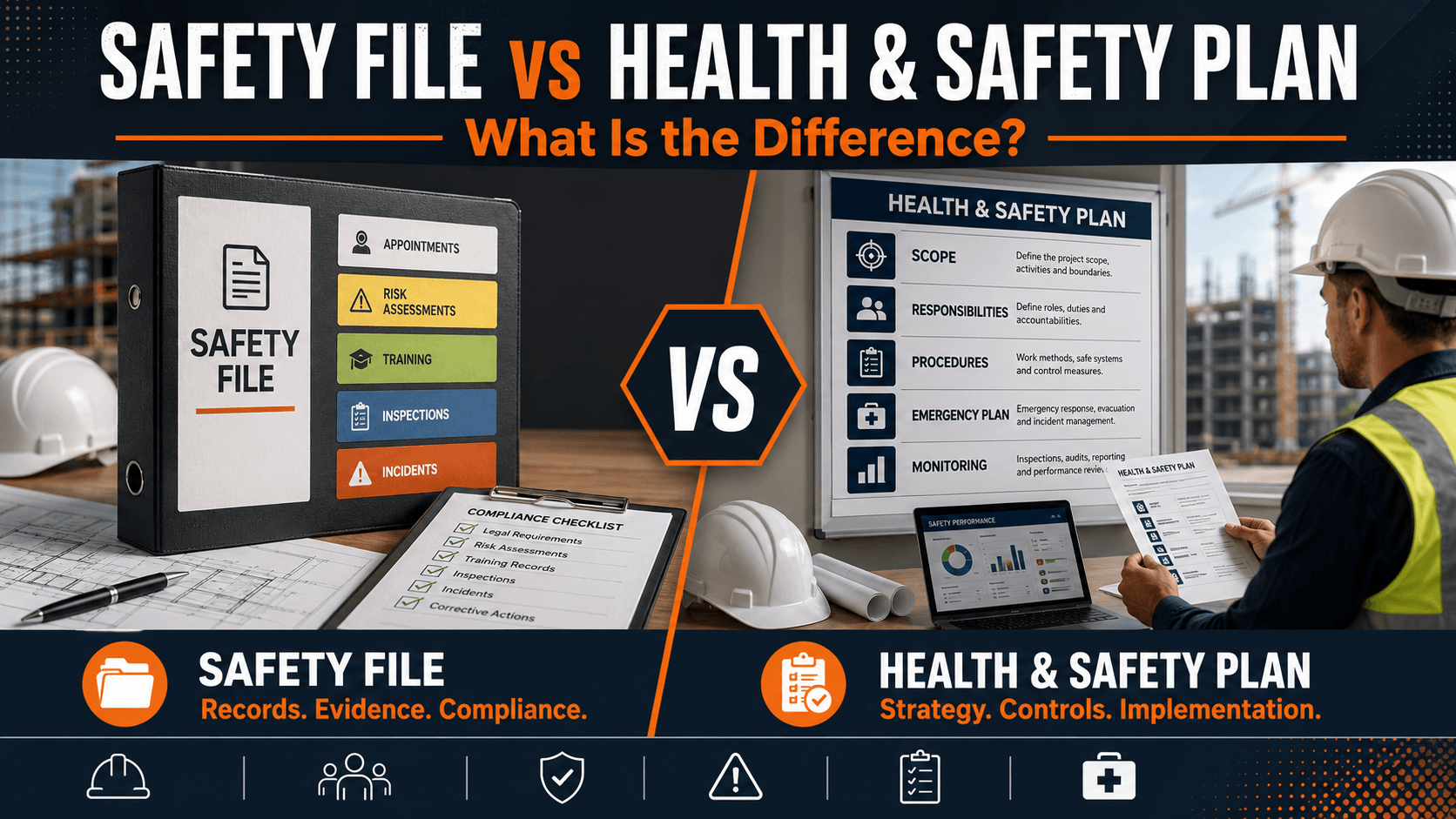

A health and safety plan explains how a contractor will manage the risks, legal duties and client requirements of a project. A safety file is the larger collection of documents and records showing that the plan is actually being implemented.
The two terms are often used as if they mean the same thing. They do not. The plan describes the intended safety system, while the file contains the plan together with appointments, risk assessments, training records, inspections, certificates and corrective actions.
If you need help preparing or reviewing these documents, Altra Medical provides a safety file service for contractors and businesses that need project-specific documentation and practical implementation records.
Direct answer: The health and safety plan explains what will be done, who will do it and how the work will be controlled. The safety file contains the plan and the evidence that those arrangements are being followed.
Why is the difference important?
A contractor can have a thick safety file and still fail an audit if the health and safety plan is generic, outdated or does not match the actual work.
The opposite can also happen. A contractor may have a good plan, but the safety file contains no proof that workers were trained, equipment was inspected or corrective actions were completed.
The simplest way to understand the difference is:
- The plan explains the system.
- The file proves that the system is being applied.
1. What is a health and safety plan?
For construction work, the client prepares a project-specific health and safety specification. The principal contractor must then prepare a suitable health and safety plan based on that specification before the relevant work begins.
The plan should explain how the contractor will comply with:
- The client’s health and safety specification;
- The Occupational Health and Safety Act;
- The Construction Regulations;
- Other regulations applicable to the work;
- The project risk assessments;
- The contractor’s own procedures; and
- Any contractual or site-specific requirements.
The plan must be specific to the project. It should not simply repeat the client specification or reproduce a company template without addressing the actual site, scope and risks.
2. What should a health and safety plan contain?
The content depends on the project, but a suitable plan normally addresses:
- Project description and scope of work;
- Health and safety objectives;
- Management structure and responsibilities;
- Legal and project appointments;
- Risk-assessment arrangements;
- Safe-work procedures and method statements;
- Induction, training and toolbox talks;
- Medical fitness and occupational-health arrangements;
- Contractor and subcontractor management;
- Plant, machinery and equipment controls;
- Personal protective equipment;
- Working-at-height arrangements;
- Emergency preparedness and rescue;
- Incident reporting and investigation;
- Inspections, audits and corrective actions;
- Communication and consultation;
- Document control; and
- Review of the plan when work or conditions change.
3. What is a safety file?
A health and safety file is the organised collection of documents and records required by the OHS Act, applicable regulations, client specification and project scope.
For construction work, the contractor must open and keep the file on site. The file develops throughout the project and should be updated as work is performed and new records are created.
The principal contractor must also manage the records of contractors under its control and hand the consolidated file to the client when the project is completed.
For a broader explanation of project duties, contractor appointments, planning and compliance requirements, see our Construction Regulations for Contractors guidance.
4. What should a safety file contain?
A construction safety file may include:
- Company and project information;
- The client health and safety specification;
- The approved health and safety plan;
- Legal appointments and proof of competence;
- Baseline, issue-based and task risk assessments;
- Safe-work procedures and method statements;
- Induction and training records;
- Medical certificates of fitness;
- Plant and equipment registers;
- Inspection, test and maintenance records;
- Personal protective equipment records;
- Contractor and subcontractor documentation;
- Emergency plans and appointments;
- Incident and near-miss records;
- Audit and inspection reports;
- Non-conformance and corrective-action records;
- Meeting minutes and toolbox-talk records;
- Certificates and expiry registers; and
- Close-out and handover records.
Related article: What Must Be Included in a Workplace Safety File? South African Checklist
5. Safety file vs health and safety plan
| Question | Health and safety plan | Safety file |
|---|---|---|
| Main purpose | Explains how health and safety will be managed | Contains the plan and proof that it is being implemented |
| When prepared | Before the relevant work begins | Opened before work and maintained throughout the project |
| Based on | Client specification, legal duties, scope and risk assessments | Legal requirements, the plan and the records generated during the work |
| Typical content | Responsibilities, systems, controls and monitoring arrangements | Appointments, assessments, certificates, inspections and records |
| How it changes | Reviewed when scope, methods, hazards or requirements change | Updated continuously as work is performed |
| Project completion | Remains part of the project record | Consolidated and handed to the client |
6. A simple example
Assume a contractor is appointed to replace roof sheeting on a warehouse.
The health and safety plan should explain:
- Who is responsible for the project;
- How roof-access risks will be assessed;
- How employees will be protected from falls;
- What training and medical fitness are required;
- How materials will be lifted;
- How the area below will be protected;
- What rescue arrangements will be available; and
- How inspections and audits will be conducted.
The safety file should then contain the evidence, such as:
- The approved plan;
- The fall-protection plan;
- Appointments and competency certificates;
- Medical certificates;
- Training records;
- Harness and equipment inspection registers;
- Anchor-point or anchor-line information;
- Daily inspection records;
- Toolbox talks;
- Audit reports; and
- Corrective-action close-outs.
Plan = intention and method. File = plan plus proof. A plan without records cannot demonstrate implementation. A file without a meaningful plan is only a collection of paperwork.
7. Is the health and safety plan part of the safety file?
Yes. The current approved health and safety plan should be included in the safety file.
The file should also contain evidence supporting the commitments made in the plan. For example:
- If the plan requires induction, the file should contain signed induction records.
- If the plan requires weekly inspections, the file should contain completed inspection reports.
- If the plan requires trained first aiders, the file should contain appointments and valid certificates.
- If the plan requires fall protection, the file should contain the fall-protection documentation and inspection records.
- If the plan requires subcontractor audits, the file should contain the audit reports and close-outs.
8. What is the client health and safety specification?
The client specification sets out the project-specific health and safety requirements that the principal contractor must address.
The relationship between the documents is:
- The client specification states the project requirements.
- The health and safety plan explains how the contractor will meet them.
- The safety file contains the plan and proof that it was implemented.
9. Can the client specification be used as the contractor’s plan?
No. The specification tells the contractor what is required, but it does not explain the contractor’s own arrangements.
The contractor’s plan should identify:
- Who will perform the duties;
- How hazards will be assessed;
- Which procedures will be followed;
- How competence will be verified;
- How subcontractors will be controlled;
- How inspections and audits will be conducted;
- How emergencies will be managed; and
- How non-compliance will be corrected.
10. Does every subcontractor need its own plan and file?
Each contractor must maintain suitable health and safety documentation for its own scope of work.
A subcontractor’s documents should address its specific:
- Scope and work methods;
- Hazards and risk assessments;
- Appointments;
- Employees and competencies;
- Medical fitness;
- Plant and equipment;
- Emergency arrangements; and
- Inspection requirements.
The principal contractor must review the documentation and make sure it aligns with the project plan and client specification.
11. Who approves the health and safety plan?
The principal contractor submits its plan to the client or client’s agent for review against the health and safety specification.
The principal contractor must also review the plans and supporting documents submitted by contractors under its control before allowing their work to begin.
The plan should be reviewed again when:
- The scope changes;
- A new work method is introduced;
- Different equipment is used;
- New contractors join the project;
- An incident identifies inadequate controls;
- An audit finds a weakness; or
- The client specification changes.
12. Who maintains the safety file?
The contractor responsible for the work must ensure that the file is opened, kept current and available on site.
A safety officer, administrator or OHS consultant may help with:
- Creating the index;
- Collecting and checking documents;
- Monitoring expiry dates;
- Filing inspections and audits;
- Tracking corrective actions;
- Reviewing contractor submissions; and
- Preparing the final handover file.
However, a consultant cannot manufacture proof of implementation. Inspections must actually be conducted, workers must actually be trained and corrective actions must actually be completed.
If you are unsure whether the documents and the actual site conditions match, an OHS compliance audit can help identify gaps between the written system and what is happening in practice.
13. Can one plan or safety file be reused?
Templates may be reused as a starting point, but the final plan and file must be specific to the new project.
Each project may have different:
- Client requirements;
- Site conditions;
- Scope and work sequence;
- Design risks;
- Personnel and appointments;
- Contractors;
- Equipment;
- Emergency arrangements; and
- Certificates and expiry dates.
Changing only the project name is not enough.
14. Common mistakes contractors make
1. Treating the file as the plan
The contractor submits a thick file but cannot identify the document explaining how the safety system will operate.
2. Copying the client specification
The specification is renamed as the contractor’s plan without explaining the contractor’s own arrangements.
3. Using a generic plan
The plan refers to hazards or equipment that are not present and omits activities that are being performed.
4. Failing to link the plan to records
The plan promises inspections, meetings and training, but the file contains no evidence that these occurred.
5. Keeping outdated versions
Several versions remain in circulation and supervisors do not know which one is current.
6. Starting work before review
Subcontractors begin work while their plans, assessments, medicals or equipment certificates are still outstanding.
7. Updating the file but not the plan
New records are added, but major changes to the scope, risks or work methods are not reflected in the plan.
15. How to check that the plan and file match
- Confirm that the plan responds to the current client specification.
- Check that the scope matches the actual work.
- Verify that appointments named in the plan are included in the file.
- Confirm that competency and medical records support the appointments.
- Check that every significant task has a suitable risk assessment.
- Ensure that procedures and method statements match the assessments.
- Compare planned inspection frequencies with completed records.
- Verify that training described in the plan was completed.
- Check that contractor controls are supported by reviews and audits.
- Confirm that emergency arrangements are supported by appointments and drills.
- Verify that findings and incidents resulted in corrective actions.
- Ensure that the current approved plan is clearly identified and available on site.
Frequently asked questions
Is a safety file the same as a health and safety plan?
No. The plan explains how health and safety will be managed. The file contains the plan and the supporting evidence showing that it is being implemented.
Which document is prepared first?
The health and safety plan is prepared before the relevant work begins. The safety file is also opened before work, but it continues to grow as appointments, inductions, inspections and other records are generated.
Does the plan go inside the file?
Yes. The current approved health and safety plan should form part of the safety file.
Is a risk assessment the same as a health and safety plan?
No. A risk assessment identifies hazards, evaluates risks and determines controls. The plan describes the broader system for managing those risks.
Is a method statement the same as a health and safety plan?
No. A method statement explains how a particular task will be completed. The plan covers the overall safety-management arrangements for the project.
Can work start without an approved plan?
The required planning and contractor-review process should be completed before the relevant construction work begins. Starting without suitable documentation may mean that hazards, competence and controls have not been properly verified.
Who receives the file at project completion?
The principal contractor must hand the consolidated health and safety file to the client when the project is completed.
Can an OHS consultant prepare both documents?
Yes. A competent consultant can assist with the plan and file. The contractor must still provide accurate information, implement the controls and remain responsible for compliance.
Need help with your safety plan or safety file?
Altra Medical Productions assists contractors with project-specific health and safety plans, safety files, risk assessments, safe-work procedures, contractor compliance and ongoing OHS system maintenance.
We can review the client specification, assess your existing documents and identify what must be corrected before work begins.
Related articles and services
- What Must Be Included in a Workplace Safety File? South African Checklist
- Safety File Services
- Risk Assessment Services
- Legal Compliance Audits
- What Is a HIRA?
- What Is a Fall Protection Plan?
Legal references
- Occupational Health and Safety Act 85 of 1993
- Construction Regulations, 2014
This article provides general information and is not a substitute for a project-specific legal-compliance assessment. Requirements must be confirmed against the current legislation, client specification, contract, scope of work and project risk profile.



0 Comments