
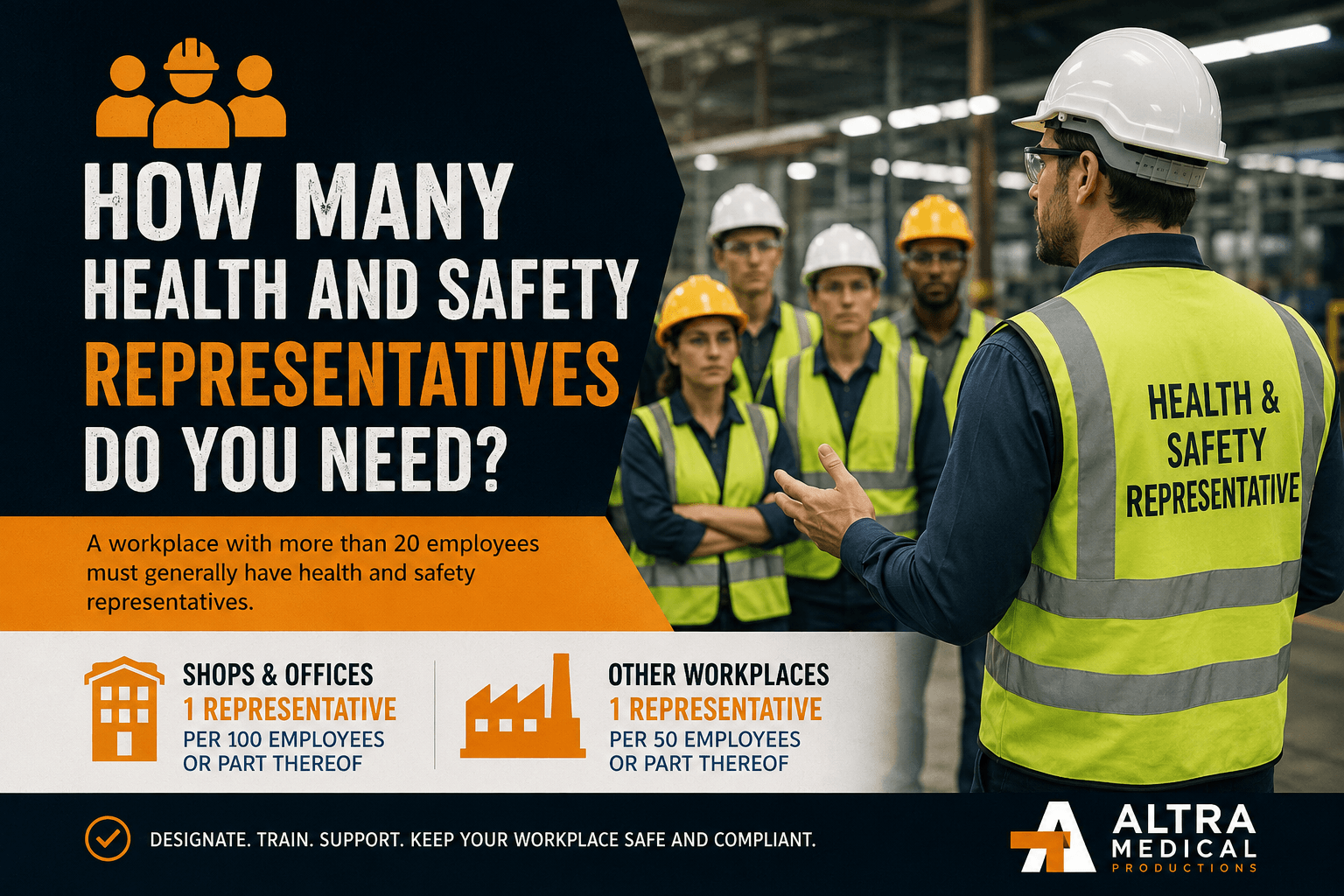

South African employers with more than 20 employees at a workplace generally need to designate health and safety representatives. Shops and offices require at least one representative for every 100 employees, or part thereof. Other workplaces, such as factories, warehouses and workshops, require at least one representative for every 50 employees, or part thereof.
The calculation is not always as simple as dividing the company’s total headcount. Employers must consider the number of employees at each workplace, the type of workplace, shifts, different departments and whether the representatives can effectively cover the areas for which they are responsible.
Direct answer: A workplace with 21 or more employees must generally have health and safety representatives. The minimum ratio is one representative per 100 employees in shops and offices, and one per 50 employees in other workplaces.
When is a health and safety representative required?
Section 17 of the Occupational Health and Safety Act requires an employer with more than 20 employees at a workplace to designate health and safety representatives.
This means that the general legal threshold is reached when the workplace employs its 21st employee.
- A workplace with 19 employees does not ordinarily require a health and safety representative under this section.
- A workplace with 20 employees does not ordinarily cross the statutory threshold.
- A workplace with 21 employees generally requires at least one health and safety representative.
The Department of Employment and Labour also indicates that the designation requirement applies where the employer has more than 20 workers and the business has been operating for more than four months.
An inspector may, however, require representatives in different numbers where the layout, hazards or circumstances of the workplace make the normal minimum inadequate.
How is the required number calculated?
The minimum number depends on whether the employees work in a shop or office, or in another type of workplace.
| Type of workplace | Minimum ratio | Examples |
|---|---|---|
| Shop or office | One representative per 100 employees, or part thereof | Retail stores, administrative offices and call centres |
| Other workplace | One representative per 50 employees, or part thereof | Factories, workshops, warehouses, plants and similar operational workplaces |
Health and safety representative calculation for shops and offices
For a shop or office, the employer must designate at least one representative for every 100 employees, or part thereof, after the workplace exceeds 20 employees.
| Number of employees | Minimum representatives |
|---|---|
| 1–20 | Not ordinarily required under the numerical threshold |
| 21–100 | 1 |
| 101–200 | 2 |
| 201–300 | 3 |
| 301–400 | 4 |
Example: an office with 135 employees
An administrative office with 135 employees requires a minimum of two health and safety representatives:
- The first representative covers the first 100 employees.
- The remaining 35 employees constitute part of the next group of 100.
- The minimum is therefore two representatives.
Health and safety representative calculation for other workplaces
For workplaces other than shops and offices, the ratio is at least one representative for every 50 employees, or part thereof.
| Number of employees | Minimum representatives |
|---|---|
| 1–20 | Not ordinarily required under the numerical threshold |
| 21–50 | 1 |
| 51–100 | 2 |
| 101–150 | 3 |
| 151–200 | 4 |
Example: a factory with 86 employees
A factory with 86 employees requires at least two health and safety representatives:
- One representative covers the first 50 employees.
- The additional 36 employees form part of the next group of 50.
- The minimum requirement is therefore two representatives.
Should you calculate representatives per company or per workplace?
The Act refers to the number of employees at a workplace. Employers should therefore not automatically combine or divide their total workforce without considering where employees actually work.
For example, a company may have:
- 45 employees at its Johannesburg warehouse;
- 18 employees at its Cape Town branch; and
- 12 employees at its Durban branch.
The company employs 75 people in total, but they are spread across three workplaces. The Johannesburg warehouse exceeds the threshold and would generally require a representative. The other two branches do not individually exceed 20 employees under the normal numerical rule.
The company should still assess whether additional appointments are needed because of the risks, work activities, layout or requirements imposed by an inspector, client or applicable regulation.
Important: Do not base the calculation only on the company’s national headcount. Confirm the employee numbers and working arrangements at each workplace.
What about employees working different shifts?
The legal ratio establishes a minimum number, but the appointment must also work in practice. A representative who only works during the day may not be available to employees on a permanent night shift.
Employers should consider:
- Day, night and weekend shifts;
- Separate departments or production areas;
- Remote work areas;
- Leave, illness and training absences;
- The risks present in each part of the workplace; and
- Whether the representative is familiar with the conditions in the area being represented.
It may therefore be sensible to designate more representatives than the statutory minimum. The Act allows the employer and employees to agree to appoint additional representatives.
Who may be appointed as a health and safety representative?
A health and safety representative should be a full-time employee who is familiar with the conditions and activities in the part of the workplace for which the person is designated.
The representative is not simply selected by management without employee participation. The employer must consult with employees and reach agreement regarding matters such as:
- The nomination or election process;
- The areas represented;
- The representative’s functions;
- The representative’s period of office; and
- The arrangements for performing the role.
The final designation should be made in writing.
Does a health and safety representative need training?
A representative cannot perform meaningful workplace inspections, identify hazards, participate in incident investigations or contribute to a safety committee without understanding the role.
The employer must provide the facilities, assistance and training that representatives may reasonably require to perform their functions. Activities relating to the representative’s designation, functions and training must take place during normal working hours.
Altra Medical Productions provides a two-day Safety Representative Training course covering the representative’s legal role, workplace inspections, hazard identification and participation in workplace safety structures.
You can also view Altra Medical’s full range of health and safety courses.
What does a health and safety representative do?
A health and safety representative may perform functions that include:
- Reviewing the effectiveness of workplace health and safety measures;
- Identifying potential hazards and dangerous conditions;
- Examining the causes of workplace incidents with the employer;
- Investigating employee health and safety complaints;
- Making health and safety recommendations to the employer;
- Inspecting the workplace, equipment, machinery, substances and protective equipment;
- Participating in consultations with inspectors;
- Accompanying inspectors during workplace inspections; and
- Attending health and safety committee meetings.
The representative supports employee participation in workplace safety. The appointment does not transfer the employer’s legal responsibility to provide and maintain a safe working environment.
For a broader explanation of the difference between operational safety roles, read The Role of a Safety Officer Explained.
When is a health and safety committee required?
At least one health and safety committee must be established at a workplace where two or more health and safety representatives have been designated.
Every designated representative must be a member of at least one health and safety committee. The employer may nominate management representatives, but the number of employer nominees serving on a committee may not exceed the number of employee health and safety representatives on that committee.
The committee must meet whenever necessary, but at least once every three months. It should discuss incidents, make recommendations to the employer and keep records of its recommendations.
Can an inspector require more representatives?
Yes. The numerical ratios are minimum requirements. An inspector may require additional representatives where the size, layout, risk profile or working arrangements make the normal number inadequate.
For example, one representative may not provide effective coverage where:
- A large plant contains several separated operational areas;
- Employees work across multiple permanent shifts;
- High-risk activities take place in different departments;
- Employees work at remote or isolated locations; or
- The representative cannot reasonably inspect and support the entire designated area.
Common mistakes employers make
1. Calculating the requirement from the national headcount
The calculation should consider the employees at each workplace, not only the company’s total workforce.
2. Using the office ratio in a factory or warehouse
The one-per-100 ratio applies to shops and offices. Other workplaces generally use the one-per-50 ratio.
3. Appointing a representative without employee consultation
A manager should not simply choose someone and issue an appointment letter without following the required consultation and nomination or election process.
4. Appointing someone who does not know the work area
The representative should be familiar with the conditions and activities in the part of the workplace being represented.
5. Meeting the ratio but ignoring shifts
A paper appointment provides little practical value when the representative is never present during the shift or in the area where employees need representation.
6. Failing to establish a health and safety committee
Where two or more representatives are designated, the workplace must establish at least one health and safety committee.
7. Providing an appointment letter without proper training
An appointment letter does not provide the knowledge needed to inspect a workplace, identify hazards, participate in investigations and make useful recommendations.
Health and safety representative compliance checklist
- Confirm the number of employees at each workplace.
- Classify each workplace as a shop or office, or another type of workplace.
- Apply the correct one-per-100 or one-per-50 ratio.
- Consider departments, shifts, leave and geographical coverage.
- Consult employees on the nomination or election process.
- Define each representative’s designated area.
- Issue a written designation.
- Provide suitable safety-representative training.
- Allow representatives to perform their functions during working hours.
- Establish a committee where two or more representatives are designated.
- Hold committee meetings at least once every three months.
- Keep appointment, inspection, meeting and training records.
Frequently asked questions
Does a company with exactly 20 employees need a safety representative?
The general requirement in Section 17 applies where the employer has more than 20 employees at a workplace. The numerical threshold is therefore normally crossed when the 21st employee is employed at that workplace. An inspector may require a different arrangement where circumstances justify it.
How many representatives does a factory with 120 employees need?
A factory falls under the one-per-50 ratio. A factory with 120 employees would therefore require at least three representatives: one for the first 50, one for the second 50 and one for the remaining 20 employees.
How many representatives does an office with 120 employees need?
An office uses the one-per-100 ratio. An office with 120 employees would therefore require at least two representatives.
Can a supervisor be a health and safety representative?
The person must be a full-time employee familiar with the relevant workplace conditions and must be appointed through the agreed employee-consultation process. Employers should also consider whether the person’s management role could undermine independent employee representation.
Can one representative cover several branches?
This is generally not a reliable approach where the branches constitute separate workplaces and the representative is not familiar with or regularly present at each location. The requirement should be assessed per workplace.
Can the employer appoint more than the minimum?
Yes. The employer and employees may agree to designate more representatives than the statutory minimum. This is often appropriate for shift work, large sites and workplaces with several departments or higher-risk activities.
When is a health and safety committee compulsory?
At least one committee is required where two or more health and safety representatives have been designated at a workplace.
Is a safety representative the same as a safety officer?
No. A health and safety representative is an employee representative designated in terms of the OHS Act. A safety officer is generally an appointed safety practitioner who assists the employer with the implementation and administration of the safety system.
Make sure your representatives are properly appointed and trained
Altra Medical Productions provides Safety Representative Training and can assist employers with OHS training, workplace inspections, risk assessments and safety-system implementation.
This article provides general information on South African occupational health and safety requirements. The correct arrangements should be assessed according to the circumstances, hazards, employee distribution and applicable requirements of each workplace.

0 Comments